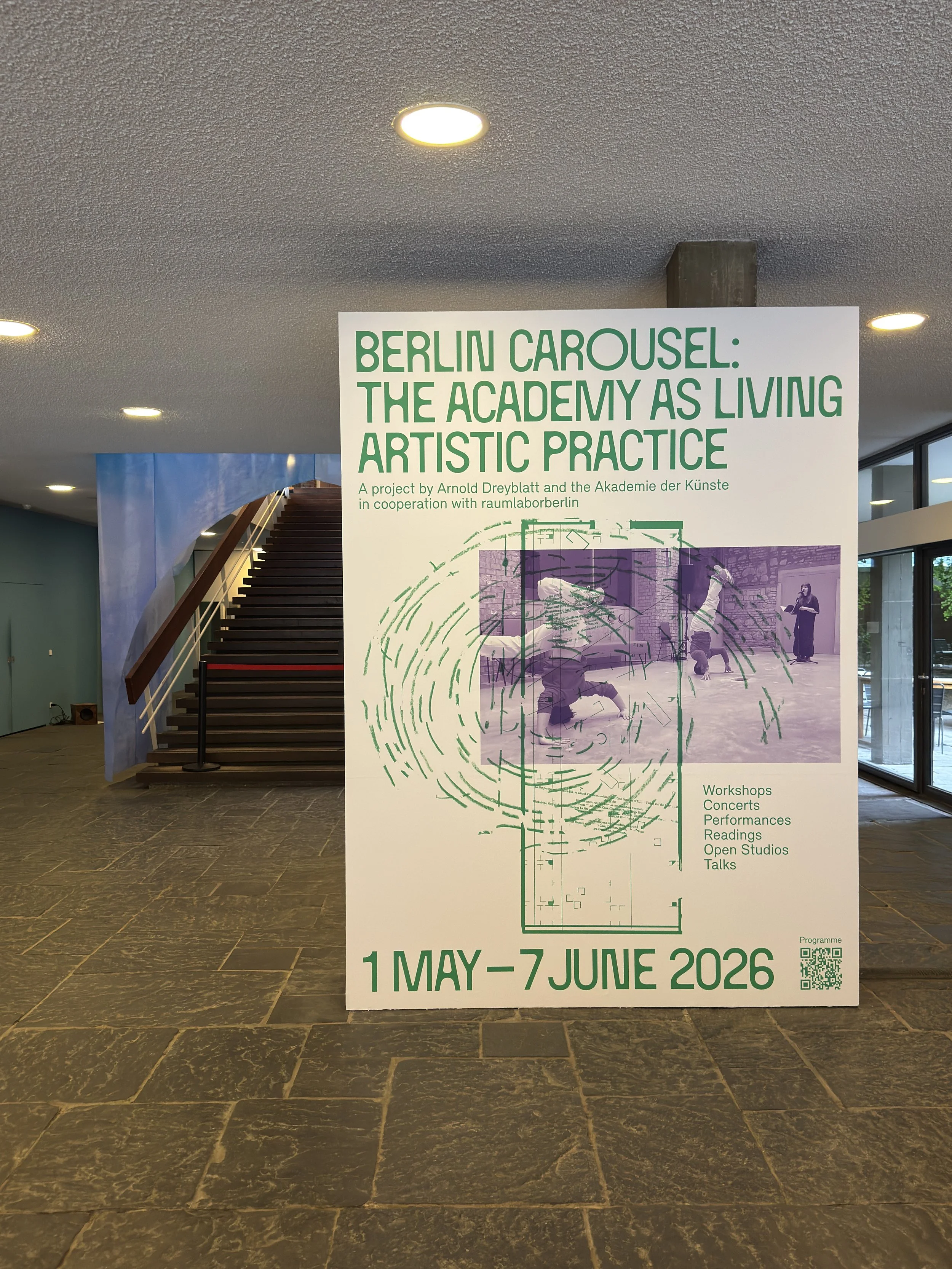
Berlin Carousel, 2026
The Academy as Living Artistic Practice
Workshops, concerts, performances, talks, readings, open studios
A project by Arnold Dreyblatt and the Akademie der Künste in cooperation with raumlaborberlin with funding from Hauptstadtkulturfonds
April 30 - June 6, 2026
Project Direction and Artistic Coordination: Anke Hervol
Over a period of more than five weeks, more than 60 international artists from various disciplines worked on artistic projects at the Akademie der Künste. The project was presented to the public as part of a non-linear composition developed by Arnold Dreyblatt.
At the core of Berlin Carousel was the idea of an interdisciplinary “working academy”. To this end, an exhibition hall, along with additional spaces, was used for a fixed period as an open, collaborative and process-oriented workshop—not for the presentation of finished works, but as a site to work in, work with, work through and work towards. It was a site for process-oriented experimentation, collaboration and work in progress.
Dreyblatt incorporated an essential insight from his project Performing the Black Mountain College Archive, where all creative activity remained open to the public—open to observation, live witnessing and occasional participation.
Since the 1990s, Arnold Dreyblatt had worked with the scoring of overlapping time sequences in order to make artistic processes visible. A central inspiration was John Cage’s interest in non-hierarchical events, for which he often used the term “circus”. Dreyblatt also drew on Cage’s Theatre Event No. 1 (1952), in which artists performed simultaneous activities among the audience within predefined time frames.
For Dreyblatt, the idea of the circus also had a personal connection. As a child growing up in New York City, his father took him to the Ringling Bros. and Barnum & Bailey three-ring circus at Madison Square Garden. It was an unforgettable experience in which multiple events unfolded simultaneously, as attention shifted from side to side to take in parallel actions across three adjacent stages, the so-called “rings”. For Cage, this became a compositional approach in which musical and performative elements occurred concurrently, often without a central focus.
Berlin Carousel took up Cage’s processes of circulation and further developed the idea of a non-centred composition. Conceived as a “rotating carousel”, the project brought together Akademie members and participants from Berlin and beyond, spanning a wide range of disciplines and artistic approaches.
The activities in Berlin Carousel were guided by a composed, non-linear time structure or score, defining times, areas and categories of use over the duration of the project. Dreyblatt also drew on Lawrence Halprin’s use of scores in interdisciplinary creative processes. Halprin described scores as a means of revealing alternatives and making hidden possibilities visible. They invite the unexpected and encourage spontaneity and interaction. According to Halprin, scores relate to temporal sequences, are non-judgemental, allow equal input and are not oriented towards a predetermined outcome.
Within this framework, Dreyblatt envisioned the Akademie der Künste as a temporary working academy in which more than 60 Akademie members and invited artists from all disciplines engaged in process-oriented research, discussion, performance and interaction. Rather than requesting specific works, the underlying concept of the project was outlined, and the artists responded with corresponding proposals, which the project team then attempted to realise.
Each week featured parallel, multi-day activities that included active public studio work—both individual practice and collective workshops and group activities—all of which were understood as forms of performative practice. These were complemented by short-term performative interventions and by ongoing installation and performative works that evolved over the course of the five-week duration. Evening programmes included concluding presentations of daytime projects, alongside further works and presentations of related historical collective initiatives.
The open project space in an exhibition hall of the Akademie building on Hanseatenweg was conceived specifically for the project by the collective raumlaborberlin. The group operates at the intersection of architecture, urban planning, the design of public space and artistic practice. Led for the project by Benjamin Foerster-Baldenius and Mariana Malhão, the team explored the Akademie’s storage areas and repurposed found elements to define functional spaces. These were complemented by an ensemble of mobile furniture and installational structures, as well as the Bubble outside and Raúl Walch’s contribution on the stairway and in front of the building. The Discursive Dinners were developed with Markus Bader and Frauke Gerstenberg.
The project space became both a place of production and a space in which the boundaries of artistic categories were crossed and expanded. A schedule displayed when individual artists or groups were active in the space. Over a period of more than five weeks, visitors were invited daily between 2 and 7 pm to observe artistic practice in progress and to participate in it. All daytime activities were free of charge, and the evening events were ticketed for a small entrance fee.
Dreyblatt, together with the entire office of the Visual Arts Section of the Akademie, was also in residence daily throughout the project, experiencing and accompanying its day-to-day transformations.
Interdisciplinarity, as well as time- and process-based art forms that could be experienced within this open working process, formed the core of the project. Berlin Carousel created a continually evolving artistic landscape—a site for process-oriented experimentation, collaboration and work in progress.
Artists, Researchers and Curators: Helen Adkins, Michael Akstaller, Hubertus von Amelunxen, Cağlasu Aslan, Jeanne Astrup-Chauvaux, Patrizia Bach, Tomas Bächli, Joseph Beuys, Arno Brandlhuber, Ethan Braun, Tony Buck, Andreas Bülhoff, Nicholas Bussmann, Anna Butter, Frieder Butzmann, Greta Casà, Benedetta Castrioto, Alfredo Costa-Monteiro, Moussa Coulibaly, Jakob Deider, Christopher Dell, DJ Shlucht, Charlotte Dualé, Leon Erhorn, Insa Eschebach, Jan Faktor, Helga Franza, Dani Gal, Elizabeth Gallón Droste, Michael Geißler, Emiko Gejic, Adam Goodwin, Manuele Gragnolati, Ulrike Grossarth, Constanze Haas, Mona Hatoum, Adrienne Herr, Christoph Holzhey, Nan Hoover, Paul Hübner, Gary Hurst, Dominique Hurth, Hwanhee Hwang, Petja Ivanova, Allan Kaprow, Käthe Kruse, Raimund Kummer, Brandon LaBelle, Labour (Farahnaz Hatam & Colin Hacklander), Elisabetta Lanfredini, Claus Löser, Anton Lukoszevieze, Daniela Marcozzi, Amir Mardaneh, Marc Matter, Magda Mayas, Nanne Meyer, Ari Benjamin Meyers, John Miller, Mouse on Mars, Christian Naujoks, Hajnal Németh, Daniel Ott, An Paenhuysen, Nam June Paik, Adam Page & Eva Hertzsch, Lia Perjovschi, Jovana Popic, Steffen Reck, Marina Rosenfeld, Stefan Römer, Andreas Rost, Eran Schaerf, Eva-Maria Schön, Anna Lena Seiser, Geetha Sridharan, Christoph Tannert, Iris ter Schiphorst, Manos Tsangaris, Margerita Tsomou, Jakob Ullmann, Maria Ustenko, Manuel de Villiers, Cécile Wajsbrot, Raul Walch, Sasha Waltz, Jan St. Werner, Nico von Wersch, Clemens Winkler, Jeremy Woodruff, Walter Zimmermann, Vizma Zvaigzne. Weitere Beiträge von: Berlin School of Sound, Internationales Künstlergremium (IKG), Internationale Gesellschaft der bildenden Künste e. V. (IGBK), n.b.k. Video-Forum, raumlaborberlin, Sächsische Akademie der Künste, Sound Practice Research Kollektiv (SPRK) der Folkwang Universität der Künste, Studio for Electroacoustic Music, Versatorium – Verein für Gedichte und Übersetzen, weißensee kunsthochschule berlin.
>>> Poster
>>> Program Poster
>>> Program Cards
Bookmark I (Lesezeichen), 2023
Jakob Wassermann - German and Jew
Installation, Jewish Museum Franken, Fürth
Three-channel Film Installation, 55 min. HD; 6 Lenticular Panels, A0 Format, Lightboxes
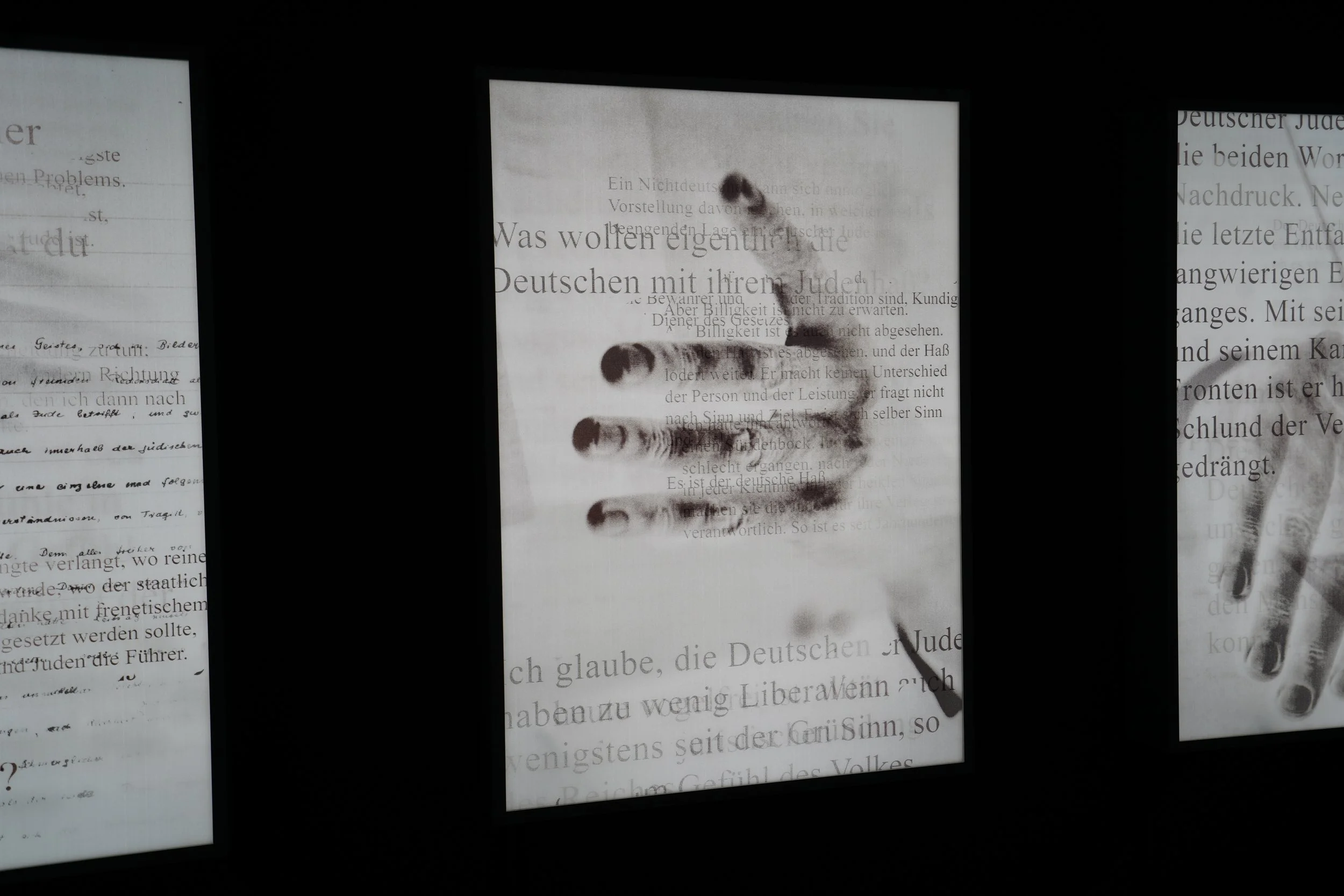
To mark the 150th birthday of Jakob Wassermann (1873, Fürth), Arnold Dreyblatt has created an installation that focuses on Wassermann‘s autobiographical work, My Path as a German and a Jew (1921). Dreyblatt invited eleven people of different backgrounds and ages to read from pre-selected sections of Wasserman‘s forensic analysis of German-Jewish relations - the result is a 55-minute scored three-channel film installation.
In an adjoining space, Dreyblatt has created a series of six illuminated lenticular panels for which he has selected photographs of Wasserman taken by Jewish photographer Grete Kolliner in Vienna in 1920, as well as texts from the original publication. Each work contains several layers of images and texts that have been read in the film installation, both of which can be perceived fragmentarily from different viewing positions.
Bookmark II (Lesezeichen), 2023
Jakob Wassermann - German and Jew
Installation, Jewish Museum Franken, Fürth
6 Lenticular Panels, A0 Format, Lightboxes
To mark the 150th birthday of Jakob Wassermann (1873, Fürth), Dreyblatt has created a series of six illuminated lenticular panels for which he has selected photographs of Wasserman taken by Jewish photographer Grete Kolliner in Vienna in 1920, as well as texts from the original publication of “My Life as German and Jew”, published in 1921. Each work contains several layers of images and texts that have been read in the film installation, both of which can be perceived as textual fragments from different viewing positions.
Biography, 2023
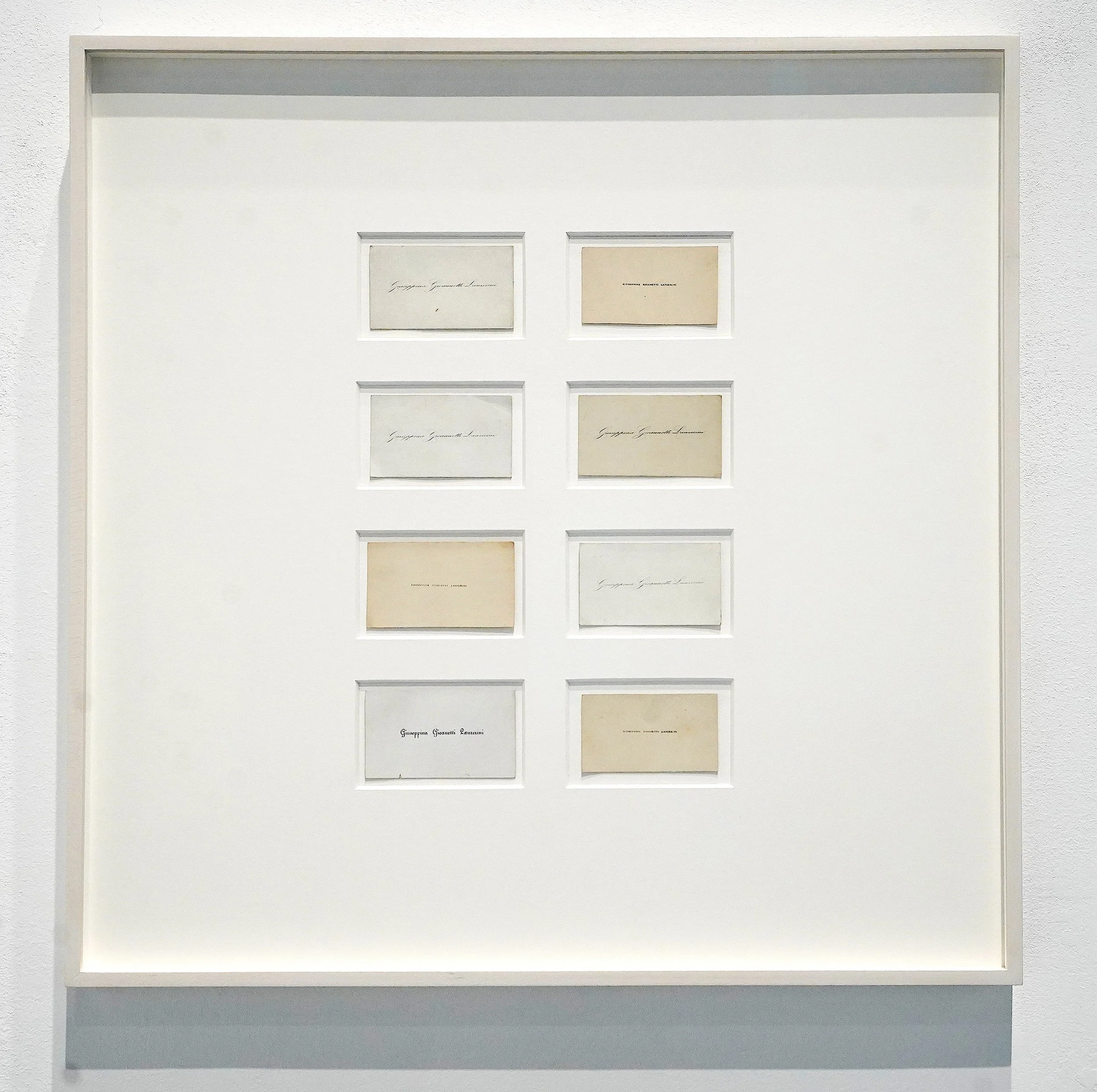
Collection of 9 Italian Visiting Cards, Framed, Individual Mounts, 60 x 60 cm
Related to the work: “Index”, 1998
Acquired in Venice, this collection of visiting cards, contain one family name: “Giuseppina Gioanetti Lauzerini”. Each card has a different typeface, and has aged differently.
Exhibited: Kang Contemporary Berlin, 2023
The Black List, 2023
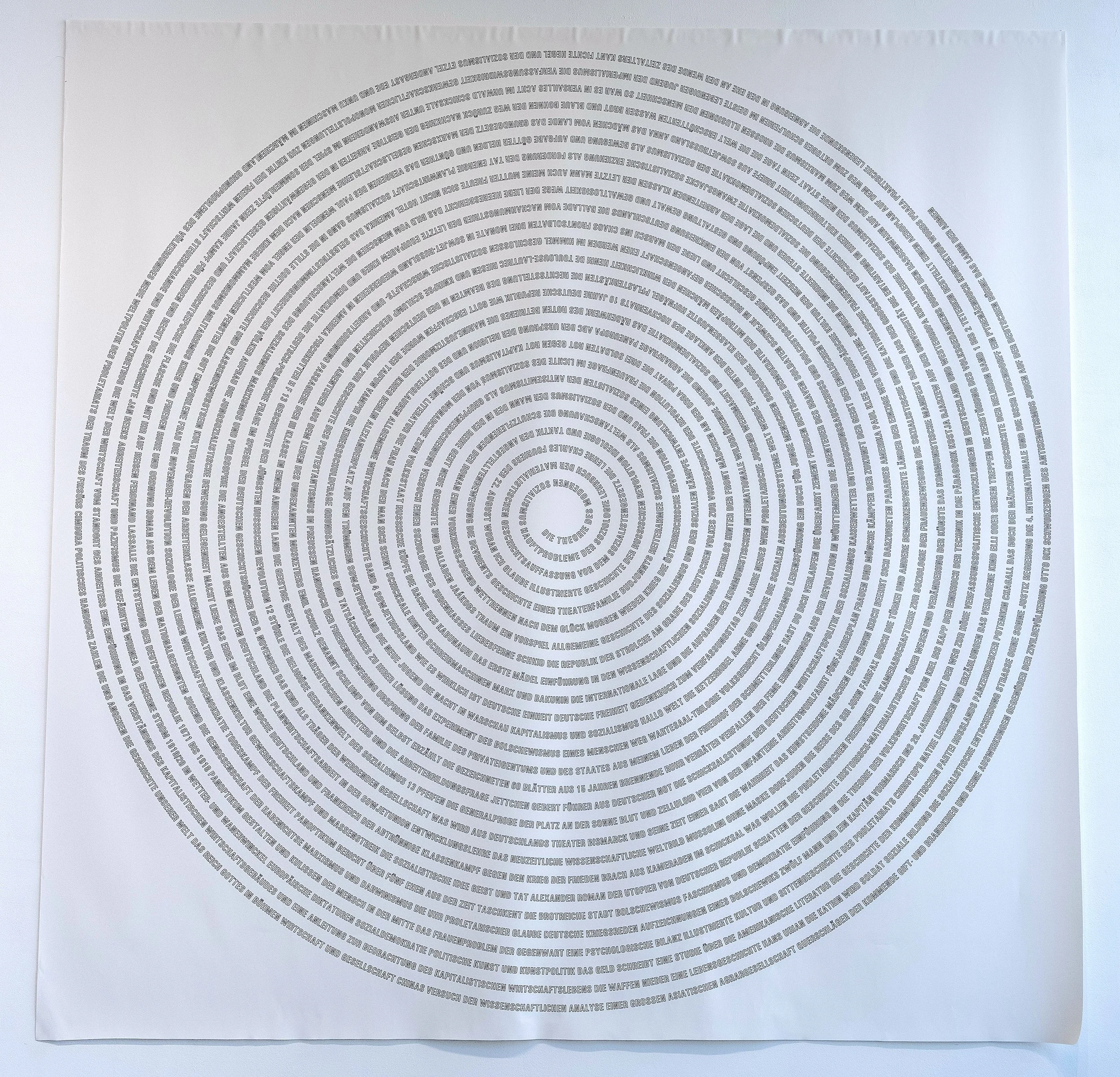
Digital Print on Canvas, 3m x 3m
This print was created from the digital file used to create a public art work with the same name, installed in 2021 at the Königsplatz in Munich.
The memorial to the 1933 book burning on Königsplatz in Munich was inaugurated on May 6, 2021. Its title, The Blacklist, refers to the lists circulating at the time with the names and works of hundreds of authors. Some of them were literary titles, others non-fiction or scientific publications, and they even included children’s books. All of them were decried by the Nazis as “un-German” and banned from public life. For his design the artist Arnold Dreyblatt used what was probably the most extensive and best known “black list.” The Nazi librarian Wolfgang Herrmann had compiled a list on his own initiative in spring 1933 and disseminated a kind of guide to “purging” libraries. Many of the organizers of the book burnings used this list to select the books to be burned. The text spiral is made up of approximately 9,600 letters
Exhibited: Kang Contemporary, Berlin, 2023
Last Europeans?, 2022
3 lenticular transparent prints, lightbox, frame, 160 x 230 cm
Commissioned and purchased by the Jewish Museum Munich. Exhibited as part of the exhibition: "The Last Europeans. Jewish Perspectives on the Crises of an Idea"
Containing texts in German, English and Esperanto by: Agnes Heller, Ludwik Zamenhof, Bernard-Henri Lévy, André Gkucksman, Daniel Cohn-Bendit, Jaques Derrida und Jürgen Habermas
Installation consists of three lenticular prints, which Dreyblatt has chosen as an interactive means of representation. Each work contains up to six text layers, which can be percieved in fragments from different viewing positions and which "overwrite" each other as in a deconstructed "palimpsest".
Interim, 2022
Single channel audio, Mono Loudspeaker
Speaker: Alexa Dvorson
Exhibited as part of the exhibition: "Internal Clocks' at the Culterim Gallery, Berlin located in a former air-raid shelter. The exhibition was curated by Claudia Breitschmid, Annabelle von Girsewald and Samuel Haettenschweiler. The installation also included "Screen Memory" (2018), an earlier video work by Arnold Dreyblatt.
The installation is comprised of two works in dialogue with one another. As one enters, the video display “Screen Memory” illuminates the space. In the site-specific audio work "interim", a pre-recorded voice and environmental soundscape addresses and questions the public as to the spatial context and history of the site.
"A female voice. The spoken word is about space, its curves and corners. The text is vague, it is complex. That is exactly what memory is. It is almost never clear, always that 1% of doubt. Have you become aware of your feelings now? It is all very vague. But aren’t memories also sometimes very confusing?" - Brigita Sinistaj
Warm-Up, 2021, 2024
4K Projection, Stereo Sound, Reading Desk, Lamp, printed musical score, Framed LP Edition
Solo Exhibition, Yellow Solo Project Space, Berlin 2021
Raum für Gäste, Aachen 2024
In 1947, Edgard Varèse composed five-minutes of unfinished fragments for orchestra titled “Tuning Up”, referring to the tuning and preparatory ritual of every live orchestra performance in which musicians gather on the concert stage before the actual concert program begins. The static yet continually changing dynamic timbre of the orchestra warm-up is often overlooked.
In reflecting on Dreyblatt’s forty-year career in musical minimalism and media art, the classical preparatory ritual of the orchestra “warm-up” is examined in a video and audio installation. Archival recordings of over fifty orchestra warm-up sessions have been edited digitally into a seamless composition in which the short durations of these pre-concert moments are prolonged. The resulting digital recording was then transcribed and notated as a musical score for orchestra. The gaze of the orchestra conductor in performance has been mapped in real-time using eye-tracking software and wearable capture tools.
Conductor, Score Transcription: Paul Brody
Eye-Tracking Realization: Dr. Markus Schönberger, iMotions A/S, Copenhagen Denmark
Camera: Veit Lup – Martin Wolff
The production of “Warm Up” was supported by: Recherchestipendien im Bereich Bildende Kunst Senatsverwaltung für Kultur und Europa Abteilung Kultur, Berlin, 2020
Special Thanks to: iMotions A/S, Copenhagen Denmark
Originally Curated by Hajnal Nemeth
Archive Carousel, 2021
Inspired by “Rolywholyover A Circus” by John Cage in a realization for an Archive.
Exhibited in “TRANSFORMING ARCHIVES - Arbeit am Gedächtnis”, Akademie der Künste, Berlin
Multimedia room installation with 77 changing objects from the Archives of the Akademie der Künste, BerlinRotating Exhibition, Wall and Spatial Installation, Score, Live Video Recording
In the spirit of "Rolywholyover", "Archive Carousel" is a non-hierarchical composition that revolves around the Archival holdings of the 325-year-old Akademie der Künste in Berlin, selecting 77 objects to generate 28 simultaneous, non-linear events. Initially, the process-oriented research project centered around an open forum in dialogue with the archivists to determine a potential list of objects. The archival holdings include textual materials (transcripts, correspondence), publications, drafts of works, art-works, museum objects, audio tapes and books from artists’ estates. The diverse and heterogeneous objects selected for "Archive Carousel" are a result of their origin from all archive divisions.
Dreyblatt's non-linear score provides an individual index, finding aid and presentation rhythm for all objects in the “visual depot”, determining how the presentation changes and thus abolishing the hierarchies between arts and materials: no artefact or document competes with another. The exchange of the archive objects according to the score are displayed as a film loop within the exhibition.
With a non-linear temporal score that provides each object with its own indexing, research resources, and presentation rhythm, "Archive Carousel" suspends hierarchies between the arts and the materials in a space that includes a built-in "viewing depot". Among the decontextualized objects, no artifact or document competes with another.
Since the 1990s, visual artist and composer Arnold Dreyblatt has applied the scoring of overlapping time sequences in varying performative installation formats. “John Cage’s pioneering work Theater Event No. 1 (Black Mountain College, 1952), in which artists on site carried out simultaneous activities of their choice within a prescribed time frame, while moving through the audience, is to this day an important reference point for my artistic work.” (A.D.). He referenced this work most recently in 2015 in his interactive installation Performing the Black Mountain Archive at the Hamburger Bahnhof – Museum für Gegenwart, Berlin.
John Cage’s Rolywholyover A Circus (1993) is a randomly generated composition in four movements: Museumcircle (museum loans, Circus (works of art), Cage-Gallery (works of art by Cage) and Media space.(2) Originally, Cage and the curator Julie Lazar had planned to compile a list of loans from museums around the world for the project, from which the specially developed ROVER computer program was to pick random objects. At the time, the low rate of digitization of museum collections prevented the realization of this idea. Instead, the two regional museums located 30 and 60 miles respectively from where the work was realized participated in the project. The Circle changed according to the specifics and regional museum density. Depending on the space available at the particular venue, the Circle comprised between 30 and 60 museum objects. The Circus, on the other hand, represented the densest part of the composition, as it was a kind of index of John Cage’s life and work, centered around availabilities and aesthetic and personal preferences. In the site-specific room design, the objects were presented in “play” or “reservoir” mode. In the spirit of "Rolywholyover", Arnold Dreyblatt references in "Archive Carousel" the notions of Circus and Circle, which describe the processes of circulation.
Anke Hervol, Arnold Dreyblatt
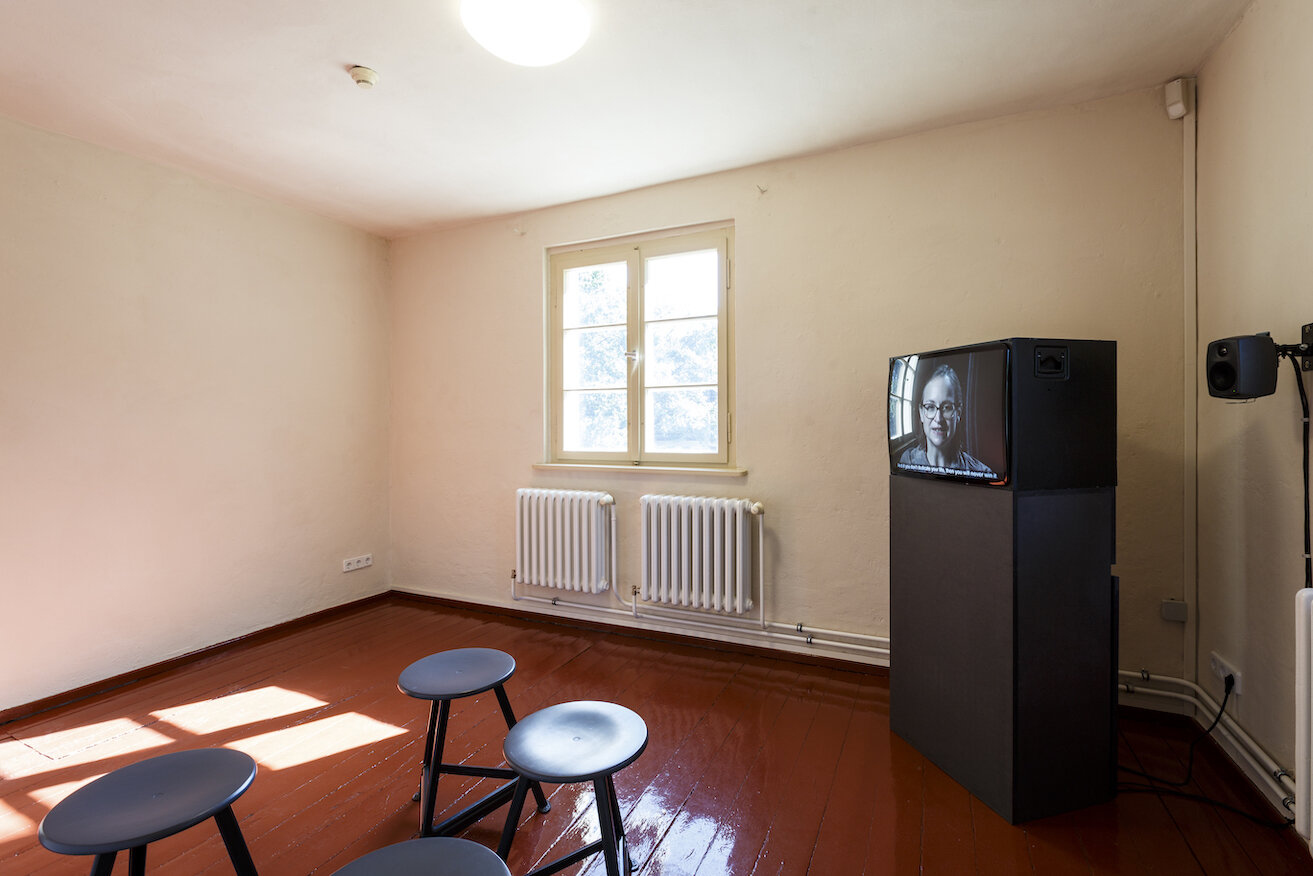
to the german woman, 2020
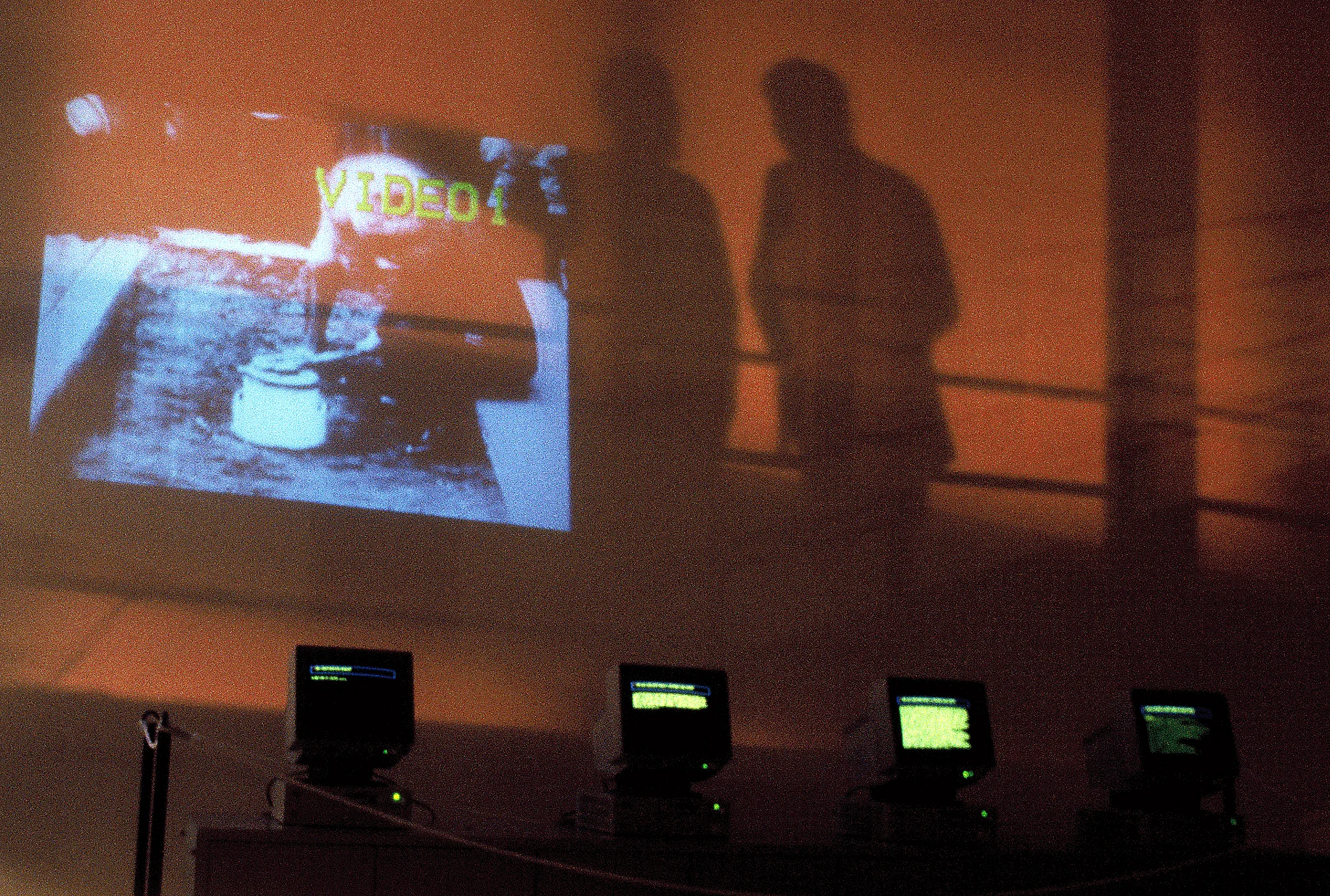
Two Channel Video Installation, two channel, SD Video, B & W and Color, 4:3 Format, Stereo Sound; CRT Monitors, Wood Platforms, Media Players
Exhibited and concieved for the exhibition:
“Artistic interventions in the new exhibition: "In the wake of the SS: images, voices and clichés: SS-Guards of the Women's Concentration Camp Ravensbrück”, 2020
Video 1: 21 :53 min, 2020; German with English subtitles
Video 2: 22:54 min, 2020; German with English subtitles
Speakers: Yvette Goetze-Hannemann, Sabine Kotzur
Recording: Zeitzeugen TV, Berlin; James Wehse, camera and editing; technical advice: Martin Wolff; Text translation: David Haney ; Transcription: Anne Steinhagen
Supported by German Federal Cultural Foundation
Arnold Dreyblatt has developed a two-part film installation: Two female speakers, who address the audience directly, give advice on how mothers should raise their children and how women should behave in National Socialist society.
At the center of this artistic exploration is authoritarian education under National Socialism. The quotations used in the first work are taken from contemporary books and magazines of the 1930s, such as the NS Women's Watch and several other guidebooks that were supported by Nazi propaganda and that pointed the way ahead for the educational methods of the Nazi national community.
The question of the after-effects of such methods after 1945 forms the core of the second work - using the example of Johanna Haarer's guidebook on infant care: “The German mother and her first child”. Published in 1934, the book became the basis for the "mother training courses" of the Nazi leadership. Until the 1970s, Haarer's book, in a version cleansed of National Socialist propaganda, was found in almost every household in the Federal Republic.
The Resting State, 2019
Installation
White wall text, SD video projection B&W, 4:3, four channel Audio
Neue Berliner Kunstverein (N.B.K.), Berlin
Curated by Michaela Richter
Arnold Dreyblatt’s research has been supported by a residency at the Center for Arts, Science and Technology, Massachusetts Institute of Technology (2014–2015); project realization in cooperation with the Studio für Elektro-akustische Musik, Academy of the Arts, Berlin.
Dreyblatt began his research into the cognitive phenomenon of the “Resting State” during a residency at the Center for Arts, Science and Technology at MIT in 2014-15.
Cognitive scientists are exploring those forms of information processing that occur when the brain is not involved in the accomplishment of specific tasks and when there is little or no outside stimuli. Subjects are exposed to a low-stimulus environment in which light and sound signals are employed, interrupting introspection at random intervals with verbal and visual cues.
In “The Resting State”, Dreyblatt focuses on the methods with which researchers attempt to document and test this essential aspect of consciousness while at the same time turning the recipient into a test subject.
Archival footage from numerous sources brings together excerpts from films showing neurological and psychological tests from the 1930s to 1960s; experiential reports and questions by test subjects and queries by researchers quoted on the walls and in the sound track question the central role that visualization and language play in our understanding of internal mental states. process of individual “mind-wandering” comprehensible.
Dreyblatt Archive, 2019
Numbered Archival Containers, Paper, Hand Stamp
At the invitation of artist Vadim Zahkarov, Dreyblatt turns his attentions to reference his own extensive archival collections. 49 Archival Containers reference contents in Arnold Dreyblatt’s personal archive collection containing project documentation and original archival documents.
The contents are displayed in archival acid free archival standard containers, each numbered with label entries and a red hand stamp. The containers are displayed in a 7 x 7 wall grid.
First Exhibited: Freehome Berlin, 2019
The Catalog, 2019
B & W Print mounted on Alubond, 43 x 60 cm.
Edition of 3
Exhibited at Freehome Berlin, 2019
The Files, 2019
Color Transparencies, Light Box, Size Variable
Images of File Folders and Documents printed on cutout transparencies as a virtual archival table.
Exhibited: Freehome Berlin, 2019
Screen Memory, 2018
Video Projection 16:9 Size Variable; Silent; 28:36; Loop
Created for the exhibition “Lapse” as part of the Lux series at Museolaboratorio Ex Manifattura Tabacchi, Citta’ Sant’Angelo (PE) Italy, September 1 to September 30, 2018.
For the exhibition, Dreyblatt created a new video work “Screen Memory” (2017) to correspond with six of his early analog video which were also shown.
Gentle wind subtly creates Moiré patterns in a screen window.
Lapse, 2018
>>> Catalogue
Lapse, 2018 Audio-Video Installation 7-Channel Video Installation; 7 automated monochord instruments, surround 5.1 sound installation, vitrines with archival documents
A site specific audio-visual exhibition by composer and media artist Arnold Dreyblatt. Curated by Marco Marzuoli and supervised by director Enzo de Leonibus as part of the Lux series at Museolaboratorio Ex Manifattura Tabacchi, Citta’ Sant’Angelo (PE) Italy, September 1 to September 30, 2018. The exhibition, installed in eight spaces within the Museolaboratorio, explored the relationship of Dreyblatt’s early video work from the 1970’s to his research into string vibration and to his emerging career as a composer within an immersive exploration of visual and audio perception.
Video Installation
For the exhibition, Dreyblatt created a new video work “Screen Memory” (2017) to correspond with six of his early video works were produced at State University at Buffalo, Center for Media Study from 1974-76 and Digitized from analog 1/2inch videotape at ZKM (Zentrum für Kunst und Media), Karlsruhe in 2017. The showing of these works represented a European Premiere and the first showing since a presentation at Anthology Film Archives in New York in 1976. These analog works explore stroboscopic color non-optical imagery and flickering moire patterning and were dispayed on the cathode-ray monitors for which they were originally created.
Historical videos Displayed: “Burst”, “Uranus, “Fluctuations, “Carbon”, “Lapse”, “Baby Essentials”.
Sound Installation
Accompanying the video works was the premier of the multi-room sound installation “Monochordo”, (2018) in which seven tuned monochord instruments are each fitted with a timed magnetic feedback and driver system which sets the strings into vibration resulting in a rising and falling chorus of harmonic resonance. The installations each had an individual amplifying system. Engineer Magnetic Driver System: Filippo del Trappeto
The electronic sound tracks of two video works mixed in space with the “Monochordo” installation.
“Turntable History” (2009) a 5.1 Surround Installation produced by Nepenthes Mastering Berlin in 2009 was installed in a circular domed space. The sounds were produced on the “Siemens Magnetom Maestro Class Magnetic Resonance Imaging System” (MRI) from the Radiology practive of Dr. Anne Sparenberg in Berlin.
Archive
In five glass vitrines which were constructed especially for the exhibition, archival documents and works were displayed from the Dreyblatt Archive (1973 – 2003), referring to his origins in film and video art, his studies with The Vasulkas, La Monte Young, Pauline Oliveros and Alvin Lucier, his research into the acoustics of strings and tuning and related ephemera from the time period.
“the magic square tuning system and how i got there”, A unique Box Edition created in 2007 for Jörg Hiller was included in the archival presentation.
„A String When Sounded Makes Many Sounds at Once“, 8mm Film by Edye Weissler from 1982, was screened at the exit from the exhibition. The film is the only moving image documentation of his early american ensemble in preparation for a concert at Real Art Ways in Hartford in 1982.
Lux 03. Lux is a research program between contemporary music and visual art. A project to promote a different form of art, in the context of museums/galleries conceived as artistic spaces of knowledge.
Thanks to Rosano P
Memory Palace Leuk, 2018
(Gedächstnispalast Leuk)
Stiftung Schloss Leuk, Wallis, CH Table, Chairs, Lamps, 12 channel Audio Playback System
For the Schloss Leuk Foundation (Stiftung Schloss Leuk) in Wallis, Switzerland, Arnold Dreyblatt created a new work involving local historical archives and object collections. His artistic work is concerned with the social practice of the archive and the associated technical dispositives in space (archival holdings, burocratic forms) and in computer science (digital databases, search tools). He juxtaposed historical documents from politics, the catholic church (social and political structure from above) and from the everyday life of the population (private archives, private collections and letters).
Live Performance: The performance took place in the entrance hall of the medieval castle, following a dramaturgical score by the artist. 10 invited non-professional readers from Leuk and surroundings performed a text choreography in the space, composed by Arnold Dreyblatt from local archive material. Reading lamps indicated the beginning and end of individual yet simultaneous readings, forming a mosaic of voices. The score was displayed in the hall.
Installation: All readings were pre-recorded at the studios Radio Rottu Oberwallis. The recordings were played back at the site of the individual readings in live performance and syncronized with the reading lamps so that the live performance could be experienced as an installation during later opening times (without live performers).
Installation: “Kartothek” (Lower Level) A virtual treasury of local historical objects („Collection Pro Leuka“ appears solely as a data map with voice and text. In the centre of the room, an unfilled Pro Leuka inventory card from the collection appears on the floor, containing the terms and order criteria with which museum workers and archives receive documents and objects from posterity. A recorded voice reads the data from 50 inventory cards, allowing the visitor to visualize the archived historical objects.
A round table discussion was held with local historians and collectors. The project is supervised on site by Carlo Schmidt, artist and artistic director of Schloss Leuk. The art historian Sibylle Omlin assisted with the curatorial preparation and mediation of the project.
In cooperation with Radio Rottu Oberwallis, and Tomtechnik Ried-Möre, CH
A catalog is in preparation.
Protocols of the Future, 2018
Installation & Performance
300 Posters, Neon Color; 4 Tables, 8 Chairs, Platform
Protocols of the Future: The F.I.U. Files was installed and performed as part of the exhibition “République Géniale“, Kunstmuseum Bern, Switzerland
The Installation was on view for four days beginning on October 10th, 2018.
Reading Performances: October 12 and 13, 2018
A performance and installation based on the founding protocols of the „Freie internationale Hochschule für Kreativität und interdisziplinäre Forschung/ Free International University for Creativity and Interdisciplinary Research“ initiated by Joseph Beuys, Klaus Staeck, and Heinrich Böll. The spirit of the F.I.U. was taken up and continued by various individuals and groups. As an alternative to the existing art academies, however, it was never fully implemented.
Selected historical sessions of the mostly male initiators and members of the F.I.U.‘s non-profit association were re-enacted by six female artist members of the International Artists‘ Committee (I.K.G.) and an actor as narrater. Name signs paced in front of the readers indicated the name of the active role being spoken (which were changed from session to session). The original protocols were adapted from the third to the first person so that the sessions would be invoked in the presenttense.
Quotations from the F.I.U. protocols formed a large-format text installation in the form of three hundred neon coloured posters placed on the Poïpoïdrom platform within the main hall of the exhibition. After the performances, participants and public were invited to take individual posters home with them.
Project Assistant: Anne Steinhagen
Narrator: Peter Zumstein
Readers Internationale Künstler Gremium (IKG):
Monika Brandmeier, Gisela Kleinlein, Silke Leverkühne, Eva Maria Schön, An Seebach, Nele Ströbel
Graphic Design: Dirk Lebahn
Special thanks to Klaus Staeck for the use of the documents.
>>BLOG République Géniale: Artikel von Sibylle Omlin, Autorin, Co-Kuratorin BONE Performance Art Festival Bern.
>>BLOG République Géniale: Kollisionen von Sinn und Zeit - Interview mit Arnold Dreyblatt von Meret Arnold
Innocent Questions: Dark Numbers, 2016
A0 Digital Print
Created in relation to the series of works: “Innocent Questions”, 2006 and “Innocent Questions: Dark Numbers”, 2016
Published as an insert poster (Size A2) in : Journal der Kunste 01, January 2017; Akademie der Künste
Exhibited:
“Transparent Bodies”, Group Exhibition, Galerie 21, Hamburg, 2017
”Arnold Dreyblatt: Selected Works and Documentation / Installation - Music - Performance 1974-2019”, Freehome, Berlin, 2019
380 Steps, 2017
A Performance of „John Cage’s STEPS, A Composition for Painting“. The remains of the installation remained as part of an exhibition.
Presented at the #JohnCageSTEPS: International Workshops and Performances at John-Cage-Orgel-Stiftung Halberstadt on October 10, 2017.
The performance involved a circular reading/performance of selected texts from „An Introductory Essay to the Doctrine of Sounds containing some proposals for the Improvement of Acousticks as it was presented to the Society of Dublin, November 12, 1683“ by Archbishop Narcissus Marsh. The original text is found in the chain library founded by Marsh in Dublin and it contains the earliest mention of the word „microphone“ in the english language.
Selected phrases from the original documents have been printed on 380 index cards which are placed on 10 music stands arranged in a circle on white paper rolls. One to three words are printed on each card which are then „shuffled“ by rearranging the order, so that chance occurances and meanings play an important role. As each text is read, it is dropped to the ground.
At the end of each circular movement, the reader's feet pass through an ink bay, so that the movement is the „STEPS“ is recorded on the paper below.
At the end of the performance, Ray Kass presented Dreyblatt with a copy of the Peters score of „STEPS“.
Innocent Questions: Dark Numbers, 2016
Data projection, generative software, lightbox, color transparencies
Arnold Dreyblatt’s media and archive-based installations focus on cultural memories and transcend the boundaries between new and traditional media. Innocent Questions is an on-going project that started in 2006: an oversized digital punch card was mounted onto the front of a manor house in Oslo once occupied by a National Socialist, and which today is a Holocaust museum and research centre. In “Innocent States: Dark Numbers”, Dreyblatt references the historical punch card, identity cards, questionnaires and other archival documents to question the daily violation of personal rights and, by association, to what extent identity is manufactured by historical and current methods of registration.
A generative data projection selects from a generic list of “innocent questions” representing administrative interactions with foreigners and minority groups, then calculates and dynamically displays a digital data punch card in real time. Located in the front of the projection wall is a light box vitrine, (8.0 x 1.0 meters), on which a collage of illuminated transparent documents are placed, referencing the international history of questionable personal data registrations. The projection and light box display is connected digitally, so that during data calculation, the documents flicker in tandem with the projection.
Software: Jens Ewald
Dedicated to William Seltzer
Related to this work: "Innocent Questions", 2006 under "Public Art"
Exhibited and Commissioned by: “Uncertain States: Artistic Strategies in States of Emergency”, Akademie der Künste, Berlin
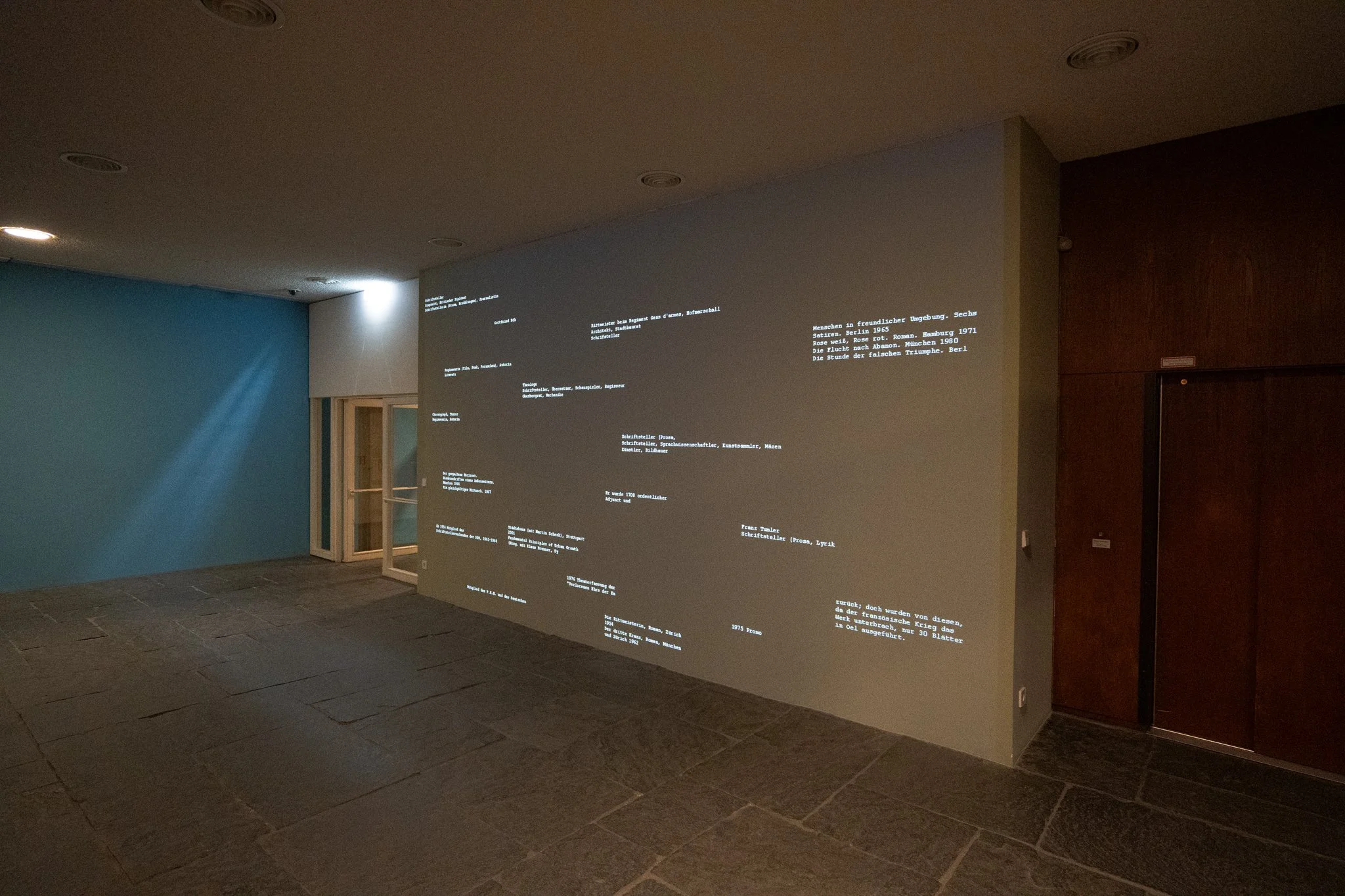
Repertoire, 2016
Data Projection, Generative Software
Commissioned by the Akademie der Künste Berlin, 2016
Software: Jens Ewald
The installation has been installed permanently in the foyer of the Akademie der Künste in Berlin Hanseatenweg since 2017.
Originally commissioned by the exhibition: “Die Akademie der Künste, Berlin Zu Gast in den Kunstsammlungen Chemnitz". for the Kunstsammlung (Art Collection) in 2016, Chemnitz.
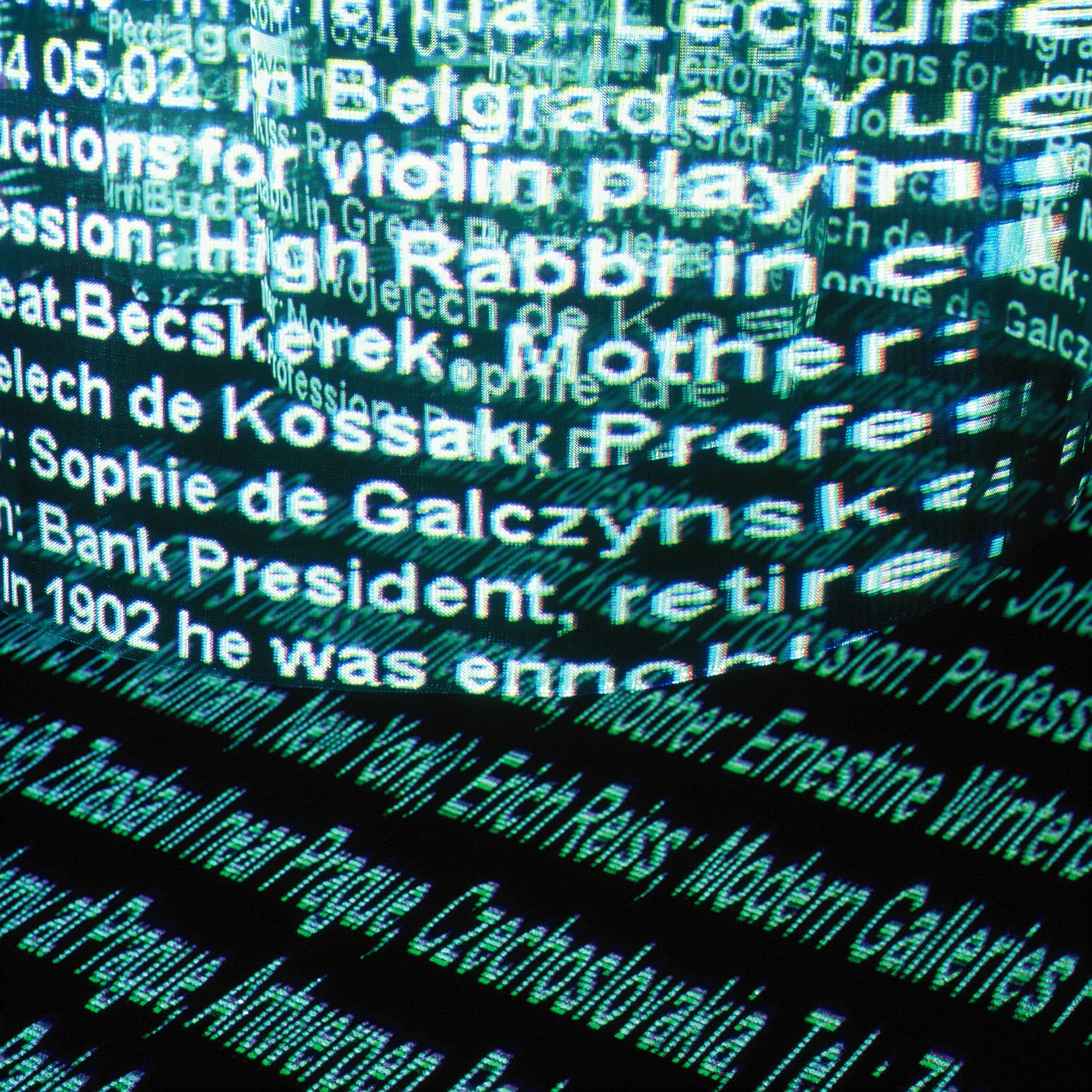
The installation is based on an updated database containing biographical information on all members of the Akademie der Künste, Berlin since 1696 (2481 Members).
The software collects biographical data through word list and categorical searches, displaying the results as scrolling text according to pre-determined graphic locations. The continually “writing” biographical fragments are in constant movement, never repeating content. Lists of artwork titles, dates and names are contrasted with historical narratives, resulting in a surprising “peek” into the membership of the Federal German Academy of Art.
“Arnold Dreyblatt focuses his media- and archive-based installations on cultural memory, crossing the boundaries between new and traditional media. REPERTOIRE is based on the history of the Akademie der Künste: more precisely, on the data of more than 2,500 members since its foundation in 1696. The repertoire of biographical, project-related and member data relevant to individual artistic careers is taken from the database of the Akademie's archives. It ranges from the artists of the Wilhelminian period such as Andreas Schlüter, Johann Gottfried Schadow, Max Liebermann, Käthe Kollwitz, Walter Jens, Heiner Müller, Werner Düttmann to current members, including Arnold Dreyblatt himself.
According to keywords and random principle, individual dates appear on the wall, whose only common feature is membership of the Academy of Arts, formerly the "Academy of the Art of Grinding, Painting and Building", then the Royal (Prussian) Academy of Arts etc. Dreyblatt structures this personal information in a new way to highlight the international community of artists who have always contributed to the development of the art of their time.”
- Dr. Anke Hervol, Akademie der Künste
The World Brain, 2016
52 Adhesive Folio Images, floor-mounted
Installed in the exhibition: "Public Library", in the Amerika-Gedenkbibliothek (America Memorial LIbrary), Berlin.
The work was installed on the floor of the foyer to the library. 52 images of photographed open books representing the International pre-war Documentation Movement along with historical publications relating to the categorization of library books. As one enters the library, one percieves what appears to be books thrown on the floor, gradually revealing their content as one proceeds. The images are photographed rather than scanned which imparts them with a three dimensional appearance. The structured organizational content of the books is contrasted with the seemingly haphazard and negligent distribution on the floor.
Works by visionary figures from the Documentation Movement such as Wilhelm Ostwald in Germany, Paul Otlet in Belgium, Suzanne Briet in France, and H.G. Wells in England are contrasted with historical pioneers in the classification of knowledge such as Albrecht Christoph Kayser, Conrad Gesner, Anthony Panizzi and Melvil Dewey.
"There is something reminiscent of an explosion's aftermath in the way in which Arnold Dreyblatt has scattered replicas of covers and pages from the works of documentation movement's members on the floor of the AGB; their visions have become reality but simultaneously, so to speak, they have met with failure: everyone uses the Internet these days, but hardly anyone has heard of those once so obsessed with knowledge and their enlightening intentions. Arnold Dreyblatt's floor installation may thus be stepped over lightly, hardly noticing." - Karolina Walter
A Classification for Cataloguing and Arranging the Contents of a Library, 2015
5 x A3 Prints, Framed
“A Classification for Cataloguing and Arranging the Contents of a Library” is based on the original explication of Melvil Dewey’s library classification system, first published as a pamphlet in the United States in 1876. As one of the earliest reformist schemes for American libraries, it formed the basis for most library classification systems now in use. By means of erasure and juxtoposition, descriptive and organizational context has been re-imagined for a fictional library.
Exhibited: Freehome Berlin, 2019
PERFORMING the Black Mountain ARCHIVE, 2015
Performance Installation
Arnold Dreyblatt's "PERFORMING the Black Mountain ARCHIVE" was an artistic research project which ran parallel to the exhibition concerning Black Moutain College: "Black Mountain. An Interdisciplinary Experiment 1933 - 1957", curated by Dr. Eugen Blume and Dr. Gabriele Knapstein at the the Hamburger Bahnhof, Museum für Gegenwart in Berlin. The diversity of activities and personalities at historical Black Mountain College provided a fertile reservoir for the development of individual and group projects, both for public performances and for artistic research in the 'Black Mountain Archive' installed by Dreyblatt.
"PERFORMING the Black Mountain ARCHIVE" comprised an on-site artistic residency which incorporated the daily live performance of archival material as readings, concerts and performances within a pre-planned time structure at pre-determined locations for the four-month duration of the exhibition. In "Performing the Black Mountain Archive" eleven art academies participated for a one to two-week period during which students were in residence within an Archive / Studio space. In reflecting the interdisciplinary nature of education at Black Mountain, students from sculpture, painting, media art, sound art, music, dance, theater and literature were invited.
The Archive / Studio functioned as the home station for the project, containing a working area for the students and the site of the Archive itself. Within the Studio area, students were visibly present during opening hours, pursuing artistic work and research. The students had access to the entire archive contents, which included not only the material used in the performances, but all archival documents which have been collected by the Arnold Dreyblatt over the last years. The live event periods took place from 11:00-13:00 and 15:00-17:00.
Resident students were involved in their own artistic research in the Archive / Studio Space when not actively performing and were encouraged to be present on-site during museum opening times. As event moments occur according the score, students would take the pre-selected archive files (or other materials) and proceed to the pre-selected event area shortly before the active event moment. During the pre-determined time bracket, the student reads / performs / or otherwise carries out the planned activity for the duration, and, upon completion proceeds back to the Archive / Studio Space when he or she returns the materials to the archive. The performative periods are indicated yet the specific times and locations of events are not specified. This ensures that the public discovers the live performances only as they navigate the exhibition.
The Project, "PERFORMING the Black Mountain ARCHIVE" was realized by students from the following educational institutions:
Muthesius Kunsthochschule Kiel (Fine Arts/Media Art): Arnold Dreyblatt & (Communication Design/Typography): André Heers und Annette le Fort
Hochschule für bildende Künste Dresden (Fine Arts): Monika Brandmauer
Hochschule für bildende Künste Dresden (Fine Arts): Ulrike Grossarth
Rheinische Friedrich-Wilhelms-Universität Bonn (North American Studies Program / German Studies): Sabine Sielke, Thomas Fechner-Smarsly
Versatorium, Institut für Komparatistik der Universität Wien
Hochschulübergreifendes Zentrum Tanz Berlin (Dance, Context, Choreography): Florian Feigel
Universität der Künste, Berlin (Sound Studies): Hans Peter Kuhn
Hochschule der Künste Bern (Master of Arts in Contemporary Arts Practice & Master of Arts Théâtre musical): Andi Schoon, Valerian Maly
Norwegian Theatre Academy Høgskolen i Ostfold Fredrikstad (Theater/Performance): Maria Schwaegermann
Kunstakademiet i Oslo (Fine Arts): Dag Erik Elgin
Institutionen för Konst, Konstfack University College of Arts, Crafts and Design, Stockholm (Fine Arts): Thomas Elovsson.
Project Coordination: Anna Schapiro
Interview >>>
visiting academies >>>
exhibition Hamburger Bahnhof >>>
Liberation, 2015
3 Video Text Projections, 2015
Permanent Installation
Ravensbrück Women's Concentration Camp Memorial
As part of the special exhibition, 'Ravensbrück 1945: The Long Way back to Life', Dreyblatt created three data projections which display the experiences of inmates when the camp was liberated. The text excerpts where selected by the Ravensbrück Memorial from their archival collections. The three text projections fade in and out rhythmically during the open exhibition periods.
Project Assistance and Video Preparation: Ofri Lapid
Exclusive Apartment on Offer, 2013
LED Flatpanel Displays, Wood Construction, Text Folio , 2013
Installation was installed in the glass Vitrine of the Deutschen Bank at Kurfürstendamm 29A, Berlin from July 7th until August 2nd 2013. The project was a collaboration between Universität der Künste Berlin, Institut für Kunst im Kontext and the Museum Charlottenburg-Wilmersdorf, as part of the city project theme for 2013 - "Destroyed Diversity" - Berlin 1933 - 1938 - 1945. With support from Deutsche Bank, Postbank and DM Drogeriemarkt
One often encounters apartment advertisements in the glass display cabinets along the Kurfürstendamm. In a contemporary context, one comes upon a real estate announcement from the 1930's. The apartment contents on offer stand out from the customary commercial setting. The title of the installation ' Eine vornehme Wohnung' is quoted from the a historical auction catalog on the Kurfürstendamm in 1935 by the AFAG (Aktiengesellschaft für Auktionswesen.) The apartment's contents, including furniture and an extensive art collection, had belonged to a Jewish family who had been forced into emigration and deportation. Catalog texts, photos of interiors and personal artifacts have been collected from this and similar auctions by the AFAG between 1934-1938. Inspired by the design of an existing real estate advertisement display in a nearby street Vitrine, Dreyblatt has installed an box-like object within the glass vitrine to announce an upcoming auction event. One peers through ten 'Peepholes' behind which are illuminated fragmentary texts and images: commericial lists of intimate family belongs, auction legalities, art valuations and photographic details which have been cut out and disconnected from their original context.
"In his work "Eine vornehme Wohnung: ein Angebot" (Exclusive Apartment - On offer) Arnold Dreyblatt finds a way to give immediate presence to an historical event, the auction of a complete household, including furniture, artworks, dishes, cutlery and personal items, which took place in Berlin in the late 1930ties. He succeeds in doing so by displaying the auctioneer's lists of the items in more or less the same manner they probably have been displayed in the historical moment: by advertising techniques in an advertising show-case placed on Berlin's Kurfuerstendamm. However, different to usual advertising, his installation hides partly the content of the vitrine, and - thus triggering the curiosity of the passersby - involves them in what has been a catastrophe for the presumably Jewish family which had to give up its household. By his installation, Arnold Dreyblatt, activates what I address an awareness of history in a given presence, a form of remembering quite different to the common historical consciousness, which reflects on history in a more or less noncommittal way." - Prof. Dr. Michael Fehr
Das Dossier, 2014
Series of 16 Lenticular Panels, mounted on Alubond, 100 x 100 cm.
The work won first prize in an invited competition which was an initiative of the Governing Mayor of Berlin, the Berlin Senate Department for Cultural Affairs, the Senate Department for Urban Development and Environment and the Berlin-Hohenschönhausen Memorial.
Permanently installed at the on the grounds of the Berlin-Hohenschönhausen Memorial (Gedenkstätte Berlin-Höhenschönhausen) the site of the main prison for internees of the former East German Ministry of State Security (MfS), or 'Stasi'.
Dreyblatt's work of art "Dossier" comprises 16 text panels for the walls of the newly designed seminar and film rooms as well as the cafeteria. These newly renovated spaces are not burdened with historical associations and are openly navigated by the visiting public.
Memories of former prisoners, official orders and contextualising texts are depicted fragmentarily in a technique on panels, which change according to the angle of the viewer. Dreyblatt uses lenticular technology as a perceptually interactive means of display. Each work contains up to five text layers, which are viewable as text fragments from varying viewing positions, and which "overwrite" each other as in a "palimpsest". As the viewer moves about the room, varying text content appears and disapears.
"Dossier" expresses the different worlds of experience by bringing together opposing genres of text. This text collage invites visitors to reflect more deeply on the site and the experiences associated with it. The artistic power of the work lies in the reduction to the medium of language in its historical-political context.
The content texts were collected during a preliminary research phase in the extensive archive found on the grounds of the memorial. The final texts are derived from copies of secret police files and personal reminiscences.
Inmates, 2013
6 Lenticular Panels, 75 x 110 cm
Commissioned by the Mahn- und Gedenkstätte Frauen-KZ Ravensbrück.
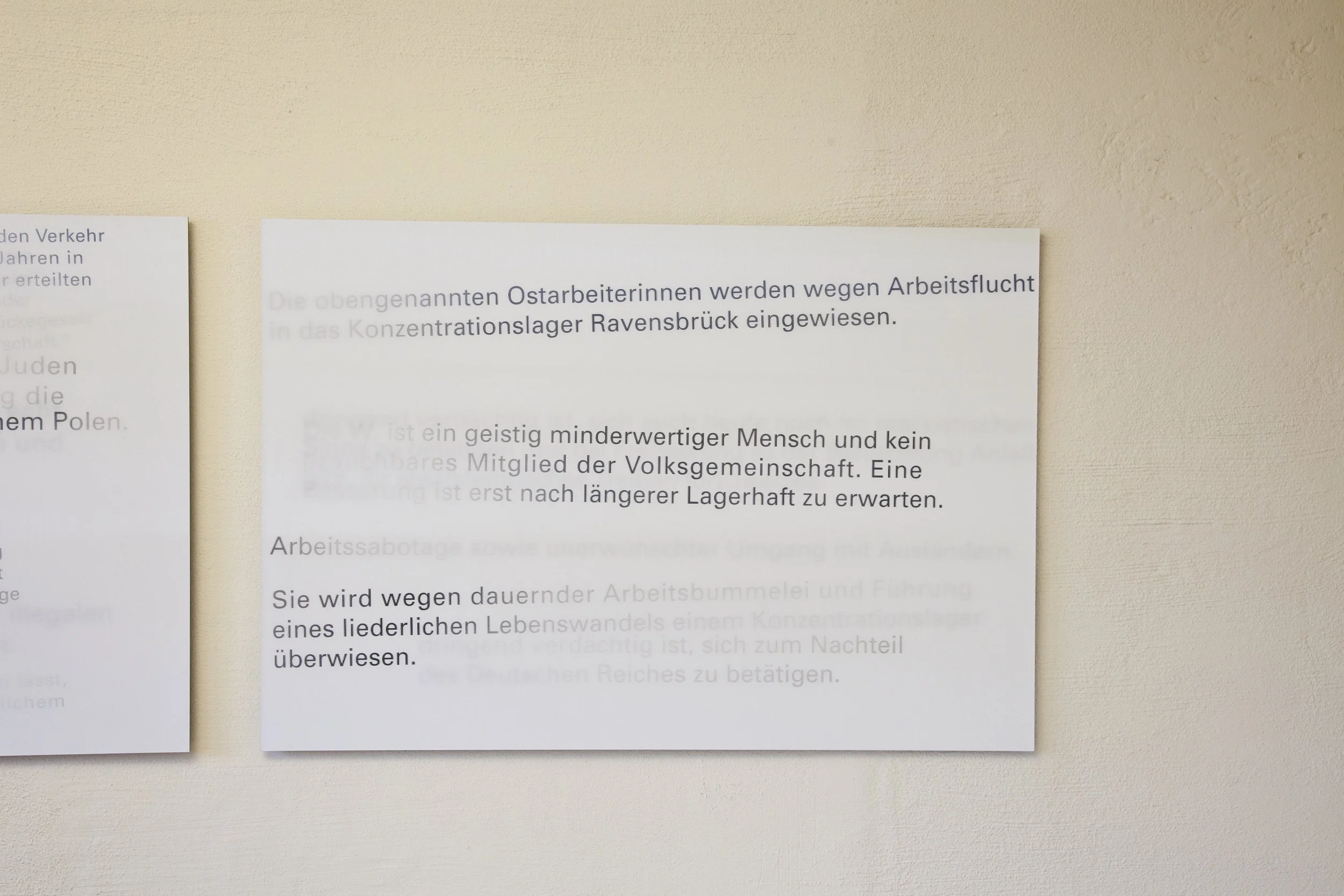
Lenticular Text Installation in two exhibition rooms as part of the new permanent exhibition at the Women's Concentration Camp Ravensbrück Memorial. Each series contains three works.
Room I: “Einlieferungsgründe”, Three works containing texts in the language of the perpetrators referring to reasons for admittance of female inmates into the camp. The fragments are based on documentation of the Gestapo and Criminal Police. The text fragments in the language of the perpetrators refer to the manifold justifications for the imprisonment of women in the Ravensbrück concentration camp.
Room II: “Sex-Zwangsarbeit in der Sprache der SS”, Three works contain quotations from letters and announcements from the years 1942-43 document the view of those responsible in the SS Economic and Administrative Main Office on forced sex work.
Dreyblatt has used lenticular technology as a perceptually interactive means of display. Each work contains up to five text layers, which are viewable as text fragmentas from varying viewing positions, and which "overwrite" each other as in a "palimpsest". As the viewer moves about the room, varying text content appears and disappears.
Kalendarium, 2013
Data Projection, Permanent Installation, 2013
Commissioned by the Ravensbrück Memorial (Mahn- und Gedenkstätte Ravensbrück) for the permanent exhibition.
The permanent work is installed in the main entrance and staircase of the Ravensbrück Memorial, so that all visitors can come into contact with a chronicle of the concentration camp from its origins to its liberation.
The projected texts are based on the documentation of the camp SS and reports by former prisoners from the memorial archive. The work visualizes recorded events in the camp, from the everyday to the most important historical moments in chronological chronology.
Texts are based on documentation of the Camp SS and reports by former inmates found in the Memorial Archives. The work is chronological and is running continuously, illustrating the recorded daily events at the camp from the mundane to major historical moments, such as the arrival of inmates, executions, etc.
As each month is randomly selected by computer software, the dates for which event information is known appear and then scroll both in German and English.
Software Markus Lerner / White Void Berlin
Event Freeze Recall, 2013
Color Translucent Print (Backlit Folio), A0
Dreyblatt's work reflects on such themes as recollection and the archive, and he has created a number of artworks related to autobiographical memory: including the installations "Flashbulb Memory" (2002) and "Recovery Rotation" (2003).
This work was originally created especially as a centerfold for the 9/11 (September 11, 2011) Edition of the Berliner Zeitung.
"We have all had the experience that in exceptional moments when startling or shocking news has been heard, the brain seems to store permanently all temporal and visual information as vivid and lasting memories. The Assassination of JFK, the fall of the Berlin Wall, and 9/11 are all examples of this phenomenon. As a born New Yorker, transplanted to Berlin, the actual moment and following hours upon hearing the news of 9/11, remain frozen and imprinted, while the days before and after have long lost their significance." - Arnold Dreyblatt
Exhibited:
Galerie Oqbo, Berlin, 2013
Freehome Berlin, 2019
The texts are derived from scientific texts based on the phenomena of Flashbulb Memory. Texts from: R. Brown & J. Kulik, "Flashbulb Memories", in: Cognition, 5, 1997, S. 73-99; RB Livingston, "Reinforcement, in: The Neuro Sciences", A Study Program, Rockefeller Press, New York 1967; U. Neusser, "Memory Observed: Remembering in Natural Context", W. H. Freeman, New York 1982; etc.
Cage Cut-Up, 2012
8 Channel Installation, Text Displays
Tonspur 52, MuseumsQuartier, Vienna
(artist-in-residence Quartier21)
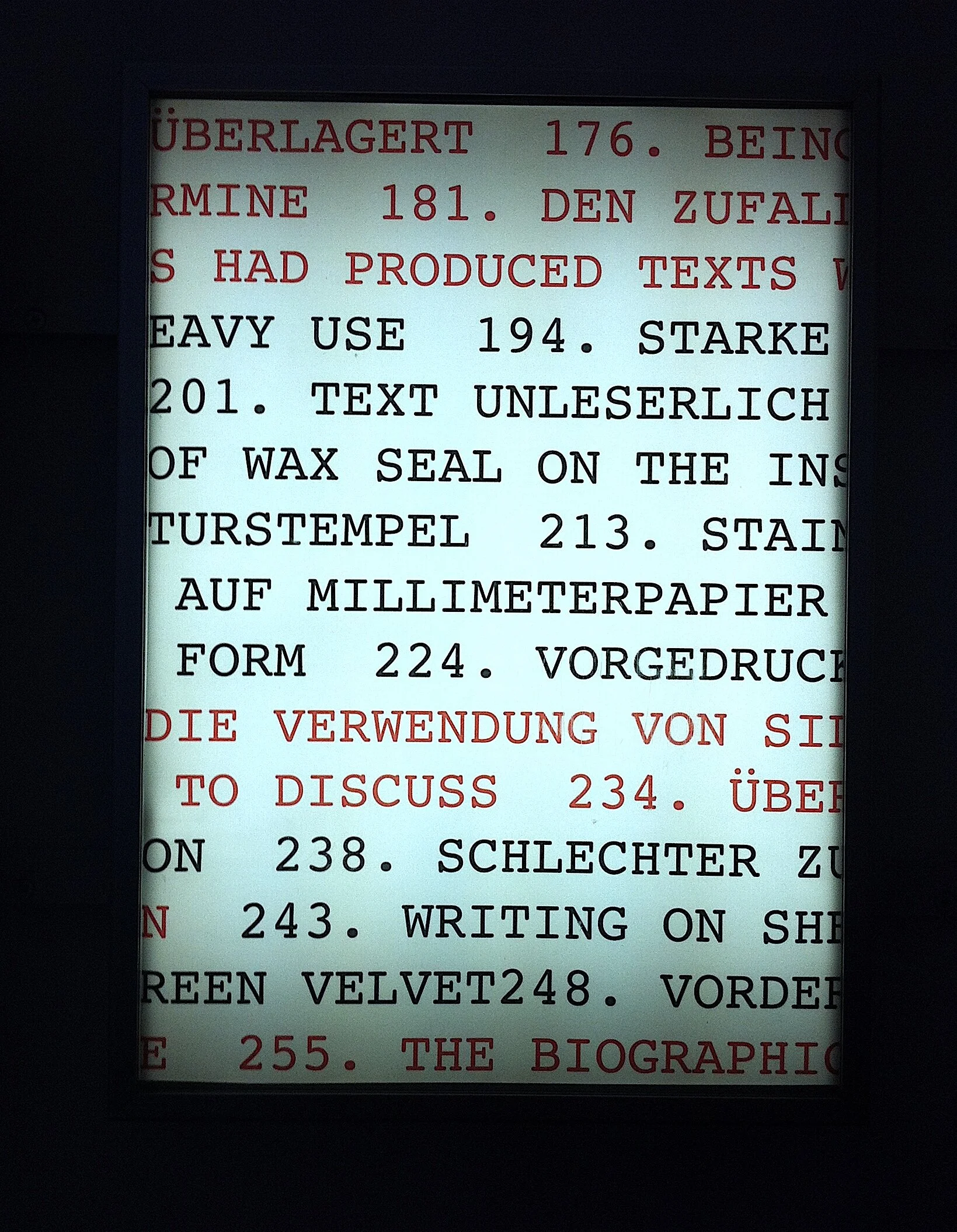
Chosen texts from “A Year from Monday, New Lectures and Writings by John Cage” (1967) which were randomly chosen from a prepared list of all sentences in which either the words ‘text’, ‘writing’ or ‘reading’ occur have been combined with another source: handwritten inventory cards from the archive collection of the Jewish Musem in Berlin. From these cards Dreyblatt selected texts which speak of the condition and readability of unnamed documents in that collection. These two, seemingly disparate text lists were further fragmented using a version of the ‘cut-up method’ invented by Brion Gysin and often utilitized by William S. Burroughs: in which texts from unrelated sources ‘meet’ each other and create new random associations. This process resulted in a final list of 329 text items, ranging from 1 to 15 words. The list was recorded and spoken by both Sam Ashley and Ray Kass, who were recent participants in the TONSPUR Project. A specially written software sends randomly chosen voice recordings from a database to the various loudspeakers according to pre-determined rules but leaving much to chance.
"We experience a possible conversation, never repeating and creating unexpected meanings. During the preparation period, I lived in a studio near to this TONSPUR_passage. I often marvelled at the diversity and density of the soundscape, in which the distant sounds of Sam Ashley’s installation, “Freedom From Happiness”, mingled with the sonorites of crowds of people passing under my four windows, and resonating in the plaza and in my living space. Over a weekend, I made numerous recordings of this situation over different times of day, and then created a carpet which lies under the voices, functioning as a kind of memory of this site from a recent, yet now lost time." —Arnold Dreyblatt
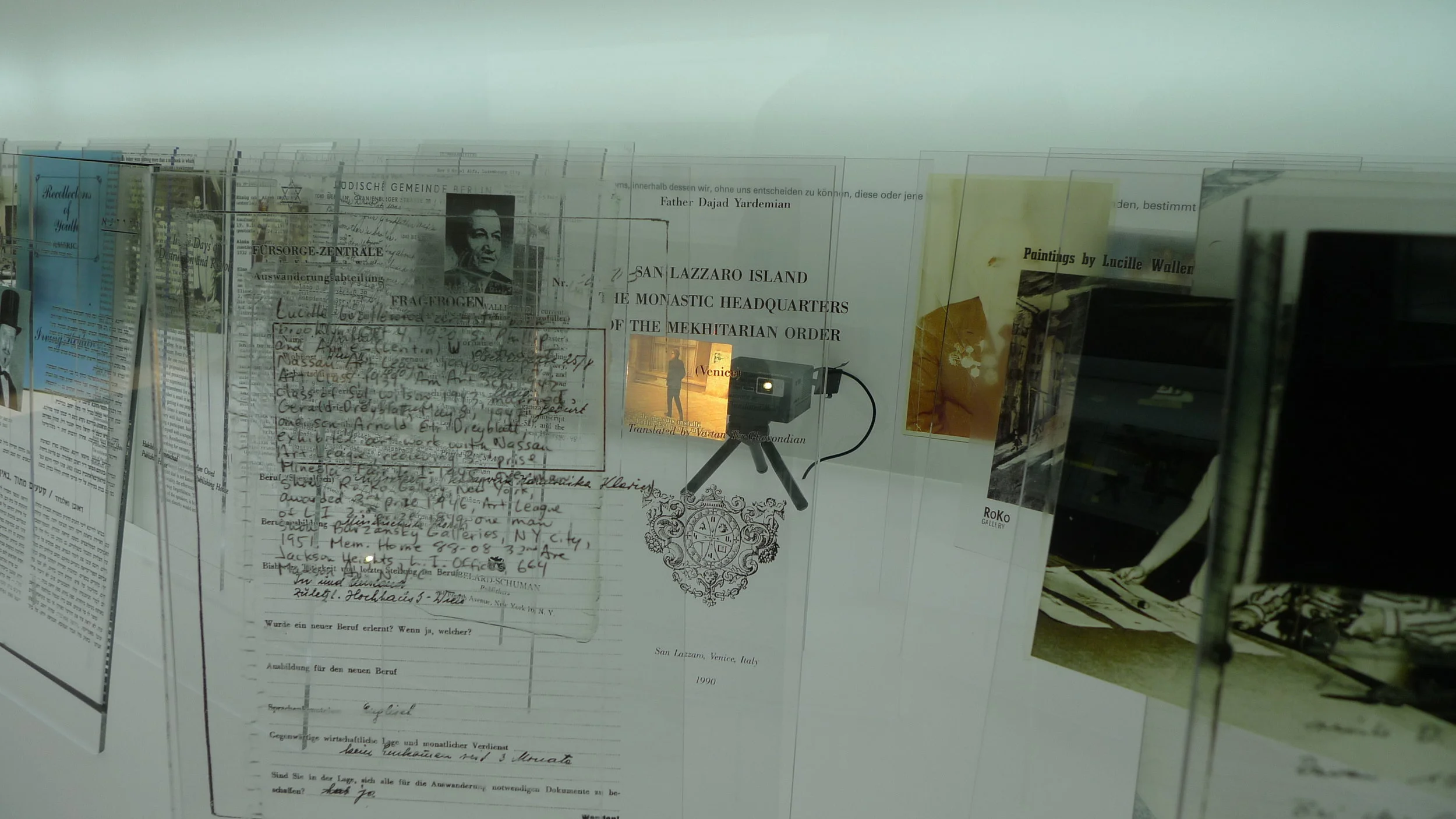
My Baggage, 2011
Installation: Vitrines, Plexiglass, Projections, Baggage Artifact,
The centerpiece of the installation is a special travelling case which was fabricated at the Oxford Fiber Case Company in Brooklyn specifically for Dreyblatt's re-location to Berlin in 1983. The case still retains his last address in the United States in Williamsburgh, Brooklyn (in a former seaman's bar at 51 Kent Avenue). Dreyblat continued to use this case during his extensive travels to Eastern Europe during the 1980's and in my later visits back to the United States.
Surrounding this case, which is displayed as an original artifact in a glass vitrine, are two enclosed L-shaped vitrine light boxes, each 2.5 meters long to be installed on platforms just under eye-level. The light boxes form both the bottom surface and back wall of the vitrine, so that one is able to percieve information content on multiple transparent layers, which combine to form unexpected encounters of autobiographical moments. Archival materials (photos, documents and video) are printed, viewed and projected in a "forest" of document sized upright standing transparent panels in such a way that one can look and read through them to deeper layers.
Contained in these vitrines is an array of hundreds of autobiographical content items, culled from his personal archive of the last twenty-eight years, were organized and cataloged expressly for this project. As in much of his artistic work, the interplay of text, light and transparency play a pivital role in the perception of historical documentation.
The archival content represents three different information layers, which in turn mirror a network of "times", "locations" and "relations": a) USA: Family Immigration and my first thirty years b) Berlin: from 1983 to the current time; and c) Eastern Europe: Family origins and personal research.
In concieving this work, Dreyblatt imagined "looking-through" paths from New York to berlin to east europe, evoking multiple biographic identities, splintered, yet related and left open to interpretation by the viewer. During the development process, a decision was made not to provide commentary or explanation of the individual items.
The installation represents one of Dreyblatt's few works which addresses the subject of archival storage and cultural memory from an autobiographic standpoint.
"My Baggage" was commissioned by the Jewish Museum, Berlin expressly for the exhibition "Heimatkunde" (2011-2012). After the exhibition ended the installation became part the collection of the museum.
Exhibition- "Heimatkünde" >>>
Das Instrument, I., & II., 2011
Two lenticular images, laminated on alubond
Texts and diagrams from: Sigmund Freud, "Traumdeutung; VII, Zur Psychologie der Traumvorgänge (B) Die Regression", 1900
"Das Instrument" (“The Instrument”) contains two Lenticular works, each 110 x 65 cm.
The texts and diagrams are excerpts from "Traumdeutung" in which Freud proposes spatial metaphors for perception and memory, and, in a second edition, footnotes a reference to his later essay "Notiz über den Wunderblock" (1925).
Lenticular technology was chosen for this work as an interactive means of display. Each panel contains five text and image layers, which are viewable from varying viewing positions, forming a "palimpsest" of fragmentary concepts.
The works were originally shown in the exhibition “Images of the Mind” at the Hygiene Museum in Dresden in 2011 along with “The Wunderblock”, 2000 which also contains a text from Sigmund Freud.
“Das Instrument II” was purchased and is in the collection of the Hygiene Museum in Dresden.
Writing Cage, 2011
7 Lenticular Objects, varying shapes and sizes
Dreyblatt has used lenticular technology as a perceptually interactive means of display. Each work contains up to five text layers, which are viewable as text fragmentas from varying viewing positions, and which "overwite" each other as in a "palimpsest". As the viewer moves about the room, varying text content appears and disapears.
The individual shapes of these seven works have been chosen from an archeological database of antique potsherds originating from ancient Greece and Rome, north and central America, the Near East and China. These shapes are the result of the "chance operations" of physical decay, a gradual historical process dating hundreds or thousands of years.
The texts are derived from Dreyblatt's original copy of the 1967 paperback edition of "A Year from Monday, New Lectures and Writings by John Cage". The text fragments used in the work have been randomly chosen from a prepared list of all sentences in which either the words "text", "writing" or "reading" occur.
Commissioned by the Akademie der Künste, Berlin, 2011
As my own work has become increasingly text-based both in performance and in installation, I have re-examined Cage's oevre in textual composition. In "A Year from Monday" he writes, "The thought has sometimes occurred to me that my pleasure in composition, renounced as it has been in the field of music, continues in the field of writing words, and that explains why, recently, I write so much." My own interests in the visual and audio perception of fragmentary layers of textual content are mirrored in seminal Cage works as "Not Wanting to Say Anything About Marcel (1969)" and in his extensive experimentation in printed text layout and vocal readings. - Arnold Dreyblatt
Material for Arcades, 2011
Lenticular Text Panel, 110 x 65,6 cm., Edition of 3
Dreyblatt has used lenticular technology as a perceptually interactive means of display. This work contains up to five text layers, which are viewable as text fragments from varying viewing positions, and which "overwite" each other as in a "palimpsest". As the viewer moves about the room, varying text content appears and disapears.
Text Content (in German): 'Materials for Arcades', Fragmentary Notes and Sketches by Walter Benjamin with Franz Hessel, (Gesammelte Schriften, vol. 5, Frankfurt, : Surkampf, 1982, pp. 1341-1347). The material was found among Benjamin's papers in typewritten and handwritten form.
1/3 from the edition is in the collection of Evan Mirapaul, Pittsburgh
Action Completed, 2010
Hand Stamp on Paper, 4 colors, 28.7 × 42.0 cm., 2010
Created for the project "Paperfile" of the Gallery Oqbo, Berlin. Limited Edition of 12 copies of 4 color hand stamp prints.
The project has been exhibited at the Preview Art Fair, Berlin and is in the collection of the Kupferstich-Kabinett, Residenzschloss, Dresden, and many other exhibtions.
Inscriptions, 2010
Permanent installation: 16 Lenticular Panels, 110 x 110 cm
Permanently installed in four meetings rooms within the new Ministry of Agriculture, Nutrition and Consumer Protection (BMLEV), Wilhelmstrasse, Berlin, and dedicated in 2010. Winner, 1st Prize, Invited Competition, Federal Ministry for Buldings and Public Spaces (BBR) Berlin, 2008
>>> Museum der 100 Orte Website
Inscriptions is concieved as an interactive textual dialogue with the employees of the Ministirium who will pass through, meet and work in four meeting rooms. Lenticular printing technology was chosen as an perceptually interactive means of display. Each work contains up to five text layers, which are viewable as text fragments from varying viewing positions, and which seem to "overwite" each other as in a "palimpsest". As the viewer moves about the room, different text content appears and disapears, allowing one to 'create' one's own narrative about the history and workings of the BMELV Ministry. In this way the employee should become participants in a dialogue with the work, which can only be 'completed' through movement and reflection.
Text excerpts are chosen as content for the work from the following themes:
a) the history of the BMELV Ministry; b) the historical and architectural context of the building; c) descriptions of activities and goals relating to the work of the BMELV Ministry; d) historical and contemporary quotations from literature and science on subjects such as agriculture, nutriton, etc.
A theme has been concieved for each of the four meeting rooms:
1. Wilhelmstr. Nr. 54, history of the building housing the Ministry; 2. Agriculture: texts from Marcus Porcius Cato (234 v. Chr. - 149 v. Chr.), Albrecht Daniel Thaer, (1752 - 1828), Johann Heinrich von Thünen, (1783 -1850) ; 3. Agricultural Politics and Policy in Germany; 4. Consumer Protection
Turntable History, 2009
Media Turntable, Data Projection, Automated Multiple Slide Projection, Mulit-Channel Sound Composition
Galerie Singuhr, Kleiner Wasserspeicher, Berlin; Produced with support of Hauptstadtkulturfonds
This text, image and sound installation was especially concieved for the circular vaulted brick space of the historical water container in Berlin-Prenzlauer Berg. Specific information content is derived from archival documentation concerning the history of the site. A media turntable spins animated text content around the inner and outer spaces of the space. Other sound and image sources are located at fixed locations on the peripheral walls. The text/image and sound material is percievable as fragments which appear and disapear throughout the media environment.
The central turntable contains two data projectors facing outwards which are connected to a computer. The text content is programmed to scroll out of view at a speed corresponding to the speed of rotation in reverse, giving one the impression that the text is standing still. The texts are projected on both the inner and outer circles of the space, at times hugging the multiple archways. Four stationary carousel slide projectors are controlled by computer software. Enlarged sections of original blueprints of the site are projected in black and white negative on the outer walls. A 40 minute five channel sound composition was created for five loudspeakers which are positioned throughout the space. The sound content is derived from recordings which Dreyblatt made of MRI Magnetic Resonance medical scanning. The project considers historical research and the collection of archival documentation an integral aspect of the project preparation. Under the direction of the artist, a research assistant collected historical materials from archives and official agencies.
Software: White Void, Berlin; Turntable: Andreas Marcksheffel; Slide Projection: AV Optics / Emmanuel S. Boatey; Historical Blueprints: Landesarchiv Berlin; Archive research and text preparation: Birgit Kirchhöfer; Archival Sources: Landesarchiv Berlin, Museumsverbund Pankow Archiv; Digital Recordings: "Siemens Magnetom Symphony Maestro Class" Magnet Resonanz Tomographie (MRT or MRI); Audio Recordings by: Jörg Hiller' Recording Location: Röntgenpraxis (MRT-Departement), Dr. Anne Sparenberg, Martin-Luther-Krankenhaus, Berlin
Inventar / Inventur, 2008
Table, Chair, Data Projection, Slide Projection
Installed in the exhibition: Recollecting, Looted Art and Restitution, Museum of Applied Art (MAK), Vienna, 2008; Raum für Gäste, 2024
Text Source: Versteigerung der kompletten Villeneinrichtung, Wien III, Kopfgasse 1. Besichtung 13., 14., und 15. Juni 1938. Versteigerung: 17., 18., 20., 21. und 22. Juni 1938; Dorotheum - Wien Versteigerungsanstalt. (Residence of Berhard Altmann).
Individual objects from a list of approximately 1400 auctioned items, including descriptions and prices from 1938, are projected as black text onto a white wall.
The white wall defines a possible space in actual size. The projection begins at floor level to simulate the dimensions of a real room. A sequence of imagined spaces is displayed one after another. Within each room type, the descriptions of objects scroll (i.e., letter by letter) to appear at the actual positions where they might be found in such a room. We are invited to imagine a virtual space that we gradually begin to perceive in three dimensions as the villa’s rooms reveal themselves before our eyes.
In the same exhibition space, Dreyblatt also presents images and documentation focusing on the history of the Jewish textile manufacturer Bernhard Altmann, who fled from the Nazis and established a production of cashmere sweaters and textiles while in exile.
M., W., M. + W., 2008
lenticular image, 120 x 70 cm.
Created for the Exhibition, "Sex Brennt - Magnus Hirschfeld's Insitute for Sexual Science and the Book Burning", in the Berlin Medical Museum of the Charite
The text image is based on a Sexual Questionaire developed and used by Magnus Hirschfeld representing possible sexual categories.
Source: Hirschfeld, Magnus: "Das Ergebnis der Statistische Untersuchungen über den Prozentsatz der Homosexuellen“, Verlag von Max Spohr, 1904
Speak Stones, 2007
lenticular image frieze, panels in 25 cm x 120 cm sections
"Speak Stones' is presented as a high-tech frieze in three sections and is intended to be experienced in lateral movement by the viewer. The fragmentary stone inscriptions are given a "voice" in our perceptions as we navigate the space.
Lenticular technology was chosen for these works as an interactive means of display. Each work contains up to five text layers, which are viewable as text fragments from varying viewing positions, and which "overwite" each other as in a "palimpsest".
Texts are derived from ancient roman epigraphic inscriptions and an anonymous early latin text on memory-technics, 'Rhetorica ad Herennium', often atributed to Cicero (1st Cent. B.C.).
Exhibited: Gallery e/static, Torino. Artissima 14 Art Fair, Torino, Galerie Oqbo, Berlin
the magic square..., 2007
“the magic square tuning system and how i got there”, 2007
Series of 27 b/w and color prints; size A4; printed on discolored antique paper and enclosed in a black box. Edition of 3.
The first edition was created for for Konrad Sprenger.
The contents, which traces the development of Dreyblatt’s early music theory and research, is based on a lecture given at Wesleyan Univeristy in 1981.
Exhibited:
Solo Exhibition: “Lapse”, Museolaboratorio, Citta’ Sant’Angelo, Italy, 2018
“Selected Works and Documentation / Installation - Music - Performance 1974-2019”, Freehome Artist to Artist, Berlin, 2019
Unsaid, 2008
Permanent Installation, Privalite Glass, Synchronized Data Projections, Computer, Mirror
Commissioned by The Jewish Museum, Berlin and installed in the historical exhibition from 2008 - 2018
The installation consists of a glass wall consisting of eight "Privalite" glass panes (each 2.5 x 1 meter mounted in steel frames), four data projectors and a large mirror mounted in the room. The installation marks a "boundary" at the end of the main exhibition, at the site of the historical representation of the Holocaust. Excerpts from letters, diaries and reports that were written before the deportation and in the ghettos and camps, as well as excerpts from messages from the National Socialist authorities that organised the mass murder, are projected onto the glass wall. Through electricity, the active and inactive Privalite glass panes become transparent or opaque - functioning as a projection surface. The scrolling text moves on the glass wall, disappears, superimposes itself and thus creates a rhythm in the room. The texts are selected and displayed at random.
The glass panels and the projectors were synchronized with the scrolling projected text. There was one projector each for two panels, representing one document fragment. At the moment when a document pair became 'active', the glass became opaque, and the document information (left side) and content information (right side) began 'writing', letter by letter, simultaneously, at eye level. From one to four active states could be happening at any one time.
The mirrored glass mounted on a diagonal wall opens the room and reflects the dynamic movement of the displays and interchangeable panels.
As source material, historical documents were selected from the Museum archives from two sources:
a. Letters from burocratic offices to individuals about preparations for deportation and eventual transports to the east.
b. The last correspondances from the Ghettos and extermination camps.
Production:
Text Preparation and Project Coordination: Maren Krüger; Media Design: Thomas Buck; Media Realisation: White Void, Berlin
Samples, 2008
Wood, Pentakta Lens, Microfiche, 2008
Created for the Exhibition, "Sex Brennt - Magnus Hirschfled's Insitute for Sexual Science and the Book Burning", in the Berlin Museum of Medical History is an institution of the Charité, Berlin (Berliner Medizinhistorisches Museum der Charité)
A four meter long reading table with 12 holes from which light is emanating. One peers into the 'peephole' lens which magnifies a small circular image of documents from a statistical analysis by Hirschfeld from 1904 and images of archival objects from the destroyed institute in Berlin which have been printed on Microfiche in miniature. One's eyes gradually focus on an illuminated miniaturized text or an object which has been magnified to the limit of perceptual readability.
The optics have been adapted from the "Pentakta HL100 microfiche hand reading apparatus" ('Mikrofilm-Handlesegerät im Taschenformat') which were produced by Pentacon Dresden for use in scientific research and by the State Security System (the STASI).
Source: Hirschfeld, Magnus: Das Ergebnis der Statistische Untersuchungen über den Prozentsatz der Homosexuellen, Verlag von Max Spohr, 1904
Construction: Olf Kreisel
Exhibited: Berlin Museum of Medical History is an institution of the Charité (Berliner Medizinhistorisches Museum der Charité); 2008
Preferences, 2008
Wood, Steel, Plexiglass, Data Projection, 2008
Created for the Exhibition, "Sex Brennt - Magnus Hirschfled's Insitute for Sexual Science and the Book Burning", in the Berlin Museum of Medical History, Charité, Berlin (Berliner Medizinhistorisches Museum der Charité)
In a room one percieves an oversized card catalog in black, as one recognizes from libraries and offices. The catalog contains thirty drawers, each fitted with the shining metal frames and handles which clearly identify their archival function. Within these frames, where normally the little paper cards which mark the contents of that drawer would be, the data is active and continually changing.
The "card catalog" was also shown with other content at the Jewish Museum in Berlin in 2007 as the work "Register" with other historical content.
Sources: Hirschfeld, Magnus: Die objektive Diagnose der Homosexualität. In: Jahrbuch für sexuelle Zwischenstufen, Jahrgang 1, 1899, S. 4 - 35 Hirschfeld, Magnus: Psychobiologischer Fragbogen. Institut für Sexualwissenschaft, VI. Auflage, 1925
Construction: Olf Kreisel; Software: Alexandr Krestovskij
Exhibited: Berlin Museum of Medical History Charité, Berlin (Berliner Medizinhistorisches Museum der Charité); 2008
Memory Lost, 2007
C-Print, Framed, 66 × 100 cm
A digital LED display in a Sicilian village square, loses access to it's memory chip.
“Memory Lost by Arnold Dreyblatt addresses forgetting through the loss of information. The photograph depicts a village square in Sicily featuring a digital LED screen that has lost all stored data. The title Memory Lost points to the disapearance of data and content stored in the digital realm. The LED screen—originally intended to communicate current information to the public—now displays only the message that it contains no information at all. Memory Lost is not merely a reflection on the loss of memory, but also on how we relate to remembrance itself. In a world where data is increasingly stored digitally, the work raises questions about the security and permanence of these memories. Dreyblatt’s piece invites reflection on the fragility of knowledge, its transience, and the significance of memory in the digital age.” - Hannes Sulzenbacher, Jewish Museum, Vienna
Exhibited:
Gallery e/static, Torino, 2007
Galerie Oqbo, Berlin, 2013
Jewish Museum Vienna, 2026
Register, 2007
Wood, Steel, Plexiglass, Data Projection, 3 Flat Displays, 2007
At the end of a long darkened corridor, one percieves an oversized card catalog in black, as one recognizes from libraries and offices. The catalog contains thirty drawers, each fitted with the shining metal frames and handles which clearly identify their archival function. Within these frames, where normally the little paper cards which mark the contents of that drawer would be, the data is active and continually changing.
In the lower area of this large piece of virtual furniture are three flat LCD screens, mounted vertically and partially disappearing into the black box. Here, an endless row of documents 'march' head-first into the 'machine' as if they being inputed for further data analysis within the catalog drawers above. The 'entry categories' of the series of documents are written dynamically on the face of the drawers, letter by letter in a series of 'chapters', each representing the data structure of a document.
Due to a built-in randomness integrated into the program processes (as to location, order, and time), the display of the data will never be exactly the same when the software program repeats its sequence. These entries are derived from the questionaires and index cards from the recently found archive of the Jewish Community of Vienna during the Third Reich era. The work was commissioned by the Jewish Museum of Vienna for the exhibition, 'Ordunung Muß Sein' ('Order must be'), and is a collaboration with the archive of the Jewish Community of Vienna.
Software Programming: Alexander Krestovsky and Gregor Kö
Production: "Anlaufstelle der Israelitischen Kultusgemeinde Wien" and "Jüdisches Museum Wien"
Exhibited: Jüdisches Museum Wien, 2007
Ephemeris Epigraphica, 2006
Series of 15 lenticular images, 120 cm x 75 cm, 2006
Comissioned by the Hamburger Bahnhof Museum of Contemporary Art, Berlin
These fifteen lenticular text images refer to Benjamin's famous essay, "Ausgraben und Erinnern" (Walter Benjamin, Ausgraben und Erinnern, in: ders., Gesammelte Schriften, Bd. IV.1, hg. von Tillmann Rexroth, Frankfurt a.M. 1972, S. 400 f.), The texts are derived from online epigraphic databases of ancient inscriptions maintained by European and North American Archaelogical research institutions (list below). Commentaries to thousands of papyrus, stone, clay and wax inscriptions were collected from these databases, specifically chosen for content referring to readability and fragmentation. Lenticular technology was chosen as an perceptually interactive means of display. Each work contains up to five text layers, which are viewable as text fragments from varying viewing positions, and which seem to "overwite" each other as in a "palimpsest".
Sources: Die digitale Papyrus-Sammlung der Universitäten Halle - Jena - Leipzig; Papyrussammlung Universität Trier; Catalogue of Paraliterary Papyrus, Katholieke Universiteit Leuven; The Egypt Exploration Society und Center for the Study of Ancient Documents, Oxford University; Epigraphische Datenbank Heidelberg, Heidelberger Akademie der Wissenschaften; Achaemenid Royal Inscriptions Database, University of Chicago; Cuneiform Inscriptions Database, University of Minnesota; Cuneiform Digital Palaeography Project, University of Birmingham
Exhibited:
Hamburger Bahnhof Museum of Contemporary Art, Berlin (as part of the exhibition; "Translation: Text as Image" within the frame of the Walter Benjamin Festival, Berlin), 2006-2007
Innocent Questions, 2006
Permanent Installation, Sandblasted Two-Way Glass, LED Displays
'Innocent Questions' was the winner of a closed competition initiated by the The National Foundation for Art in Public Buildings, Oslo (Utsmykkingsfondet for offentlige bygg) in 2004 for a permanent artistic work in front the Villa Grande, a villa occupied by Vidkun Quisling from 1941-1945. The Villa is currently the site of the "HL Senteret", The Center for Studies of Holocaust and Religious Minorities.
In developing a concept for an artistic intervention for the Villa Grande Dreyblatt preferred not be limited by the particular historical circumstances associated with this site. He chose rather to focus on the use of the 'personal questionnaire' in population registration systems as the defining element that thematically connects the Holocaust in Norway with other genocides of the twentieth century and with the administration of foreigners and other minorities in contemporary society.
In Dreyblatt's concept for a permanent installation at the site, a list of 'Innocent Questions,' derived from historical and contemporary sources and representing a composite collective questionnaire, is contrasted with the image of a historical 'punch card.' Together, this is a representation of the collection, archiving and application of personal data by political systems for administrative and often questionable use.
The winter snow and the dramatic approach up the hill to the site call for a vertical installation as a transformation of the imposing and grotesque historical building facade. In renovating and reconstructing the 'Villa Grande,' fire and safety regulations required an external stairwell to be fixed on the facade to the left of the main entrance. I proposed to utilize the structure of the stairwell in order to physically support the installation of "Innocent Questions."
Attached to the structure of the stairwell is an array of twelve panel-boxes, mounted within a steel frame. These panels are designed to form one unified image (size: 8330 x 4070 cm.), which is perceived in three distinct optical layers:
Non-Reflective Image: Sandblasted onto the hardened surface of the outermost glass layer of each panel is a reconstruction of a historical 'punch card' , representing the reduction of the individual to number and category. This image is perceived as non-reflective, creating a heightened contrast to the reflectivity of the underlying mirrored surface.
Reflected Environment: The work functions as a mirrored wall that reflects the natural environment: the trees and sky, and the visiting public. The face of the historical building is thereby opened and partially erased.
Illuminated Texts: Mounted onto the rear of each panel within the punch card image, are words and phrases written in fixed light-emitting diodes (LED's). This textual content has been derived from historical and contemporary personal questionnaires.
The rear of the work is sealed, and the illuminated red LED texts appear as an ephemeral image, suspended in the reflecting mirror. Only the illuminated LED texts are seen through the mirrored glass, which is otherwise fully reflective of the environment. The words and phrases appear and disappear within a slow and randomly generated temporal composition perceived within the virtual punch card image. Because the appearance of illuminated words and phrases is continually changing, new combinations of words and phrases arise, igniting unexpected associations from the questionnaire entries as one passes the work. During the hours of daylight, the mirror glass reflects the trees and sky. The information layers (non-reflective image, reflected environment and illuminated text) are clearly visible. In the hours of darkness, artificial side lighting illuminates the non-reflecting sandblasted surfaces of the outer glass layer, which would otherwise be imperceptible.
Public Art Work >>>
"Innocent Questions" >>>
Replica, 2005
Wood Frame, Plexiglass, Microfiche, Lens
12 works, 90 x 70 x 5 cm. are hung in a series on a long wall. Each work contains a wooden frame, a wooden panel, a layer of reflective plexiglass, a miniature lamp, a magnifying optic, and an adjustable microfiche/microfilm holder. The optics have been adapted from the 'Pentakta HL100 microfiche hand reading apparatus' ('Mikrofilm-Handlesegerät im Taschenformat') which were produced by Pentacon Dresden for use in scientific research and by the State Security System (the STASI).
In the center of the plexiglass-covered wood panel, one finds a small hole with a lens, from which light is emanating. One peers into the 'peephole' lens which magnifies a small circular image of documents from the full collection of 98 pages which have been printed on Microfiche in miniature. One's eyes gradually focus on an illuminated miniaturized text which has been magnified to the limit of perceptual readability.
The twelve texts are derived from the German and Austrian Bureau of Standards for data destruction: 'Vernichten von Informationsträgern',Deutsches Institut für Normung, Berlin, and 'Aktenvernichtung',Österreichisches Normungsinstitut, Vienna. While much of Dreyblatt's work often reflects on the process of collecting, storing and archiving information, here the text speaks of the technical and planned disapearance and destruction of our collective memory by institutions and governmental agencies.
Exhibited:
Jewish Museum Frankfurt am Main, 2005
Galerie Maniere Noire, Berlin, 2017
Missing Letters, 2005
Digital Projection, Wood Construction, 2005
One enters a high darkened space in which one percieves a black monolithic box, approximately 145 cm. high which dominates the space. One is able to move in a narrow passageway partially on two sides of this block, as one gradually percieves a rectangular sunken area, 2. x 1.35 meters, from which light emanates. From specific positions, one might percieve the movement of text on the lower surface of this depression, but since the 'horizon' of the raised floor is almost chin-level for most observers, the content and use of this 'secret' area remains unknown.
One then ascends a nearby stairwell, arriving at a second level which functions as a viewing platform. From here, one looks directly down upon this sunken area, with it's associations to graves and archaeological diggings. The surface of the depression in the floor is now fully visible, revealing an active, dynamic sea of text below, originating from a rear projection inside the block.
Textual fragments from "The Old Jewish Cemetary in Frankfurt am Main" by Michael Brocke have been chosen which contain no specific names or dates, but rather speak of the fading content and physical condition of the ancient tombstones. Additional phrases in Hebrew, selected from common expressions used in grave inscriptions of the period, create a background of floating letters. The textual fragments seem to appear from a 'sea of texts' only to gradually deconstruct and disapear again, without end, simulating a palimpsest of broken stones.
Data Projection: Alexandr Krestovsky
Exhibited and Commissioned by: Jewish Museum Frankfurt am Main, 2005
Concordance, 2003, 2005
Multi Monitor DVD display; 2003
One perceives an endless text dynamically fluttering on miniature black monitor. The downward flow of text from top to bottom of the screen is interrupted continually by a lateral left-right movement, resulting in an instability, and a degree of illegibility
The text is derived from textual fragments which have been collected from the card catalog of the Jewish Museum Archive in Berlin. The archive contains objects which have been donated to the Collection before the current location. The texts describe the condition of the donated objects and documents.
The work has been displayed in two forms on two occasions:
Galerie Anselm Dreher, 2003: Three miniature TFT displays hung on a wall in a dark room.
Jewish Museum Frankfurt, 2005: The work is situated in the section of the Museum in the Judengasse in Frankfurt, where an archaeological site may be entered. The monitor is positioned inside a deep brick well, and is only viewable from a specific standpoint near the entrance.
Recovery Rotation, 2003
Rotating Stroboscopic Text Apparatus, 2003
A motor-driven rotating cylinder, 80 centimeters high and with a diameter of one meter, mounted on a stand. The core of the cylinder contains an wired array of 100 flashbulbs which face the outer surface. This surface is composed of multiple layers of plexiglass and film which appear white when inactive.
Approximately every seven seconds, an extremely intensive 360 degree flash illuminates eleven circular text phrases which are inscribed into the cylinder surface. As the cylinder is slowly turns, one percieves new text fragments with each flash, which are only readable as an afterimage in the brain, white letters on a black background.
The texts are derived from scientific texts based on the phenomena of Flashbulb Memory. Texts from: R. Brown & J. Kulik, "Flashbulb Memories", in: Cognition, 5, 1997, S. 73-99; RB Livingston, "Reinforcement, in: The Neuro Sciences", A Study Program, Rockefeller Press, New York 1967; U. Neusser, "Memory Observed: Remembering in Natural Context", W. H. Freeman, New York 1982; etc.
The installation Recovery Rotation was created in cooperation between the Festival "Conceptualisms: Contemporary Receptions in Music, Art, and Film", commissioned by the Akademie der Künste Berlin, and made possible by funds from the foundation Hauptstadtkulturfonds and the Stadtgalerie Saarbrücken.
Exhibited:
Akademie der Kunste, Berlin, 2003 (Commission)
Stadtgalerie Saarbrücken, 2003
Galerie Oqbo, Berlin, 2014
Eight Paths, 2003
C-Prints, Wall Text, 2003
25 Color Prints positioned in a grid and layered over a wall of text. The photographs were taken in an east european botanical garden. Plants are marked by a labyrinth of small signs, from which the text has been removed or is unreadable. The wall text is an excerpt from the "Preface" to Stages on Life's Way" (1845), Søren Kierkegaard, an essay on memory.
The work addresses quesions of readablity through interruptions created by image as a reflection on the attempts of the mind to access and navigate fragments from the past.
Exhibited:
Galerie Anselm Dreher, Berlin, 2003
Retrospect, 2003
Plot, Black Letters on Coated Canvas, 2003
The work was installed in the Galerie Anselm Dreher in 2003. The text roll is approx. 1.20 x 5 meters and is tied with cord to the walls of the space. The material is bowed in such a way that from the given viewing platform, the text disapears into a landscape of letters on the horizon. The lines of text read backwards from the viewing point, until they disapear.
The positive black of the text gives way into a negative reading, as the white between the letters turn into rivolets, streams and navigations ways. The work addresses quesions of readablity through interruptions created by image as a reflection on the attempts of the mind to access and navigate fragments from the past, where time and visual perspective collide.
The text is an excerpt from the "Preface" to Stages on Life's Way" (1845), Søren Kierkegaard's essay on memory and recollection.
Exhibited:
Galerie Anselm Dreher, Berlin, 2003
Galerie e/static, Torino, 2007
Kang Contemporary, Berlin, 2023
Flashbulb Memory, 2002
Stroboscopic Text Installation, 2002
Three wall-mounted stroboscopes with text on film. The stroboscopes flash in a staggered six second sequence. The work is displayed in a darkened space. The texts are phrases which chosen from perceptual descriptions of "Flashbulb Memory".
Text 1: FRAME FREEZE
Text 2: EVENT RECALL
Text 3: NOW PRINT
Exhibited:
Galerie Anselm Dreher, Berlin, 2003
Gallery e/static, Torino, 2007
SMAC, Berlin, 2014
The Wunderblock, 2000
MDF Table and Chair, Internally mounted TFT-Display and Computer, 2000
In 1925, Freud wrote a text that compares the faculty of memory to a child's toy known as a Wunderblock. It consists of a wax slab stretched with cellophane, upon which a text may be inscribed, and just as readily erased by lifting the cellophane layer up and away from the wax slab. In contrast to Freud's model, in which the pressure of the act of inscription onto the cellophane surface continues in the direction of the underlying layer of wax, in 'The Wunderblock', the original selection and entry of data has been concluded in the past. The movement originates from ROM and is held in RAM, before travelling up towards the surface.
Quite independently of our own states of presence or absence, the installation searches and inscribes autonomously. One has the impression that the underlying textual sources can never be perceived in their entirety. Because the many texts fragments are inscribed and erased simultaneously, one can read a given fragment only with difficulty before it vanishes. The model of memory demonstrated here is at once highly unstable, fragmentary, incomplete, perishable and ephemeral. The sentence fragments appearing and disappearing on the screen describe a process of finding and loss, safeguarding and destruction.
Texts from: Sigmund Freud, "Notiz über den Wunderblock", Wien 1925; "A Glossary for Archivists, The Society of American Archivists", Chicago 1992
Software: Alexandr Krestovskij
Exhibited:
Galerie Anselm Dreher, 2000
Art Forum, Berlin, 2000
Gemäldegalerie, 2001
Stadtgalerie Saarbrücken, 2003
Kunstverein Hannover, 2003
Jewish Museum, Frankfurt am Main, 2005
Science Museum / Institute of Psychoanalysis, London, 2011
T-Mail, 1999
Data Projection, Black Plexiglass, 1999
One thousand documents have been entered into a database which reports the life of T., (b. 1879 Paks, Hungary - d. 1943 Shanghai, China), a forgotten Central European historical figure whose multiple identities span three continents (Europe, North America and Asia) and touch on many of the most important events of the pre-war period. The work is derived from a larger collection of over 4,000 intelligence documents from State Archives in Europe and North America from the inter-war period.
The collection contains daily reports and correspondances between 1915 and 1943, forming a vast communication network in which the official traces and observations of the individual are cross-referenced to historical events, international personalities and geographic locations.
In the interactive display of 'T-Mail' new documents are chosen randomly from the database, a scan of the next document gradually slides into view as various thematic categories and cross-links are activated. Text writings are simultaneously emitted sonically as morse code, in five different sine wave frequencies which change with consecutive paragraphs.
Texts: The Public Record Office and The British Library, London; The National Archives, Washington, D.C.; Bundesarchiv Koblenz; Politisches Archiv des Auswärtigen Amts, Bonn, etc.
Exhibited:
Hamburger Bahnhof Museum für Gegenwart, Berlin, 1999-2000
Stadtgalerie Saarbrücken, 2003
Related Web Project: http://www.leuphana.de/tmail
In the World-Wide-Web version called "T.Mail", a selection of hundreds of documents are available as navigatable HTML pages using the "Petal" browser developed by the Department of Culturual Studies at the University of Lüneburg. The information is available through multiple categorical menues, through marked text in the document scans, and through a flash geographic time-line display.
Produced in collaboration with students of the Department of Cultural Studies of the University of Lüneburg, Germany, 2003-2005
The ReCollection Mechanism, 1998
Black room, computer data projection, suspended wire mesh, sound equipment. Size variable. 2008
An automated writing and recitation machine is found in a darkened black space. One enters a three dimensional data architecture where the process of searching, sorting and locating words and the overlapping inter-textual linkages of information are simulated optically by metaphors of transparence and complexity. Projected onto a barely visible cylindrical screen are multiple transparent layers of continually flowing historical data, which appear to be suspended in the center of the space, and which delineate the room contours with textual landscapes.
Two computers randomly search and locate thousands of words within an endless virtual page of biographical information in real time. As each word is found, it is highlighted visually and spoken out loud by a male or female voice. The voices gradually cross each other in time, creating a dialog. The viewer participates in a deconstruction of history through a non-linear and associational reading of forgotten archival fragments.
Texts from: Who's Who in Central & East Europe 1933
Design & Software Development: Luca Ruzza Studio, Rome
Software Consultant: Alexandr Krestovskij
Sound: Tom Korr
Exhibited:
Felix Meritis Foundation, Amsterdam, 1998
Hamburger Bahnhof Museum für Gegenwart, Berlin, 1999-2000
Jewish Museum, New York, 2001
Arte in Memoria, Ostia Antica, Rome. 2002
Stadtgalerie Saarbrücken, 2003
Artificial Memory, 1999
Plotted Text Scroll, Illuminated Vitrine, 1999
50.13 meters x 90 cm
This archive about archives questions the permanence of data storage, presented as discussions between professional archivists and in institutional reports, most of which were collected in the internet. The archive becomes a metaphor for a resistance against forgetting and loss.
The work is presented in a darkened room which is illuminated by the antique form of an enormous paper scroll, seemingly without a beginning or an end, representing a sacred object with biblical overtones. The scroll is mounted on a wooden base containing florescent tubes, with a glass surface. Each line of text extends to 18 meters, flowing on to the beginning of the next line. The eye follows this stream of content, until one loses one's horizontal location - resulting in a shifting of one's visual attention as one springs vertically to a new starting position. 997 text fragments and thumbnail images from various digital and archival sources, collected 1993 - 1999. All entries are time-stamped from the moment of collection.
Exhibited:
Hamburger Bahnhof Museum für Gegenwart, Berlin, 1999-2000
Stadtgalerie Saarbrücken, 2003
Draiflesson Collection, Mettingen, 2015-16
Index, 1998
Collection of italian Visiting Cards, Framed, Individual Mounts
Collection of 81 individual visiting cards, acquired in Venice, August, 1992; white frame, 140 x 105 x 4 cm., individual mounts.
Originally exhibited as "La Scalinate di Piazza d'Italia", 1994:
A staircase in an decaying back house in East Berlin. A collection of one hundred Italian visiting cards from the turn of the centruy, which the artist discovered in a junk store in Venice, each with only one name and no address or phone number, are encased in individual transparent plastic envelopes and nailed to the underside of 100 steps, arriving to the highest landing in the attic. As the public ascends, each card gradually appears at eye level, a collection of 100 faceless vanities of Italian royalty.
Exhibited:
"Index", 1998:
Foreign Ministry, National Parliament, Oslo, Norway (Permanent Collection)
Galerie Bleibtreu, Berlin, 2004
Galerie Kai Hilgemann, Berlin, 2003
"La Scalinate di Piazza d'Italia", 1994
Galerie Ozwei, Berlin, 1994
Responsa, 1996
Wooden Table, Six Monochrome Monitors, 1996
The discussions are presented as a digital automatic writing. The computer monitors are antique, with an association for an earlier technological era. The texts are fragments of conversations which write themselves as individual voices, simulating a digital conversation.
Texts from: collection of discussions on the Internet between international Archive and Record Managers. Themes include: decay of archival materials, natural disasters, filing systems, technological advances in record management, the Patron Saint of Archiving, etc.
Exhibited: Arken Museum for Modern Art, Cultural Capital of Europe, Copenhagen, 1996
Time Capsule, 1995
Welded Steel Container.
The "Time Capsule" was first exhibited within the interactive installation work, "Memory Arena" (1995-96).
The contents are not indicated and the work is inscribed with the following text:
TIME CAPSULE
DEDICATED 22, November, 1963 A.D.
TO BE OPENED. 4 Juli, 2776 A.D.
CONTENTS UNKNOWN
"Time Capsule, a container storing historical documents and objects that is to be opened at some future date. The contents, which, may include historical documents and artifacts, are intended to reveal something about contemporary civilization to future generations. A capsule is often prepared to commemorate a notable event, such as a World's Fair or the landing on the moon. It is generally buried in the ground."
Exhibited:
Arken Museum for Modern Art, Cultural Capital of Europe, Copenhagen, 1996
Stadtgalerie Saarbrücken, 2003
in the exhibition "FOUNTAIN 100" in Flutgraben e. V., Berlin, 2017
TIefbau Kabinett, 1994
Archaeological Artifacts, Books and Documents, Glass, Earth
In an old cellar in East Berlin, two simulated 'archaeological' finds create moments for a reflection on museum display of historical artifacts.
Behind a wooden gate, in an individual coal cell, forty 'found' handwritten notes, documents, annotated printed books from before World War II lie haphazardly on a dirt floor. Each fragment is lit and magnified by a hand magnifying glass, and numbered.
On an adjoining wall, a stone vitrine contains 'found' ceramic and glass objects from another century, also carefully numbered for display.
Exhibited:
Galerie Ozwei, Berlin, 1994
The Church and the Machine, 1992
Laminated Digital prints, Wire Track
Digital prints, format DIN A1, laminated, moveable and suspended on wire track.
Texts on the subject of a robotic mass storage system in which files are ordered and physically moved by a robot monk/librarian and an American church-sect which is pursuing an extensive worldwide archiving project collecting and storing personal data.
Data is presented on a track containing large hanging plastic cards which can be moved back and forth at will, containing information on an international 'high-tech' computer frm and an American church-sect which is pursuing an extensive worldwide archiving project.
'The Church' has been collecting and storing the personal data from over 15 Million persons from around the world for over 50 years in 1.6 million rolls of microfilm which are stored in Utah in the Western United States in a cave safe from nuclear attack. Each year 30,000 new rolls are added and the material is made accessible to the public at Family History Centers worldwide. This project is the largest of its kind ever conceived, and as its goal seeks to collect store, and digitize all genealogically useful information which can be located before eventual disappearance.
Exhibited:
Galerie Ozwei, Berlin, 1992
Kulturfabrik Kampnagel, Hamburg, 1995
Arken Museum for Modern Art, Cultural Capital of Europe, Copenhagen, 1996
The T Documents, 1992
84 chronological archival documents, plastic envelopes, format DIN A4, nails with spacers
'The T Documents' is one of a number of related works derived from over 4,000 intelligence documents from State Archives in Europe and North America from the inter-war period which have been collected by the artist.
These documents reveal the life of 'T'., (b. 1879 Paks, Hungary - d. 1943 Shanghai, China), a forgotten Central European historical figure whose multiple identities span three continents (Europe, North America and Asia) and touch on many of the most important events of the pre-war period. The collection contains daily reports and correspondances between 1915 and 1943, forming a vast communication network in which the official traces and observations of the individual are cross-referenced to historical events, international personalities and geographic locations.
In the installation 'The T Documents', the artist's personal selection of 84 original archive documents have been digitized and faked by specially developed printing techniques applied to the reverse side of postwar East German archival pages, posing question about the identity of both the subject's personality and the authenticity of the documents themselves. The documents are displayed in chronological order in transparent envelopes hanging on metal hooks. Selected excerpts are translated and typed in German on small strips of paper which has been inserted into the envelopes.
In a related work, "T-Mail" (1999), thousands of documents have been entered into a database and are displayed by computer projection. A realization for the World Wide Web was prepared in collaboration with the University of Lüneburg, Department of Cultural Studies in 2005.
Sources: The Public Record Office and The British Library, London; The National Archives, Washington, D.C.; Bundesarchiv Koblenz; Politisches Archiv des Auswärtigen Amts, Bonn, etc.
Exhibited:
Galerie Ozwei, Berlin, 1992
Kulturfabrik Kampnagel, Hamburg, 1995
Bayerisches Staatsschauspiel; Marstall, Munich, 1995
Arken Museum for Modern Art, Cultural Capital of Europe, Copenhagen, 1996
Hudobné simulakrá. Jozef Cseres, Bratislava 2001
Jewish Museum, Frankfurt am Main, 2005
Gallery e/static, Torino, 2007
Akademie der Künste, Berlin, 2010
>>> Related Web Project
The Scrolls, 1992
Digital Paper Plot, 1992
Digital plot on paper, 91.5 cm. x 4.5 m.; mounted on wooden poles painted black, horizontally placed on floor
Texts: Who's Who in Central & East Europe 1933
Lists of fragmental details such as addresses and organizations which were sampled from the 'Who's Who in Central & East Europe' database and are printed on large endless text scrolls using an architectural plotter and are mounted on wooden poles. These scrolls represent both an archaic form of writing, seemingly without a beginning and an end, as well as a sacred object with biblical overtones.
Exhibited:
Galerie Ozwei, Berlin, 1992
Kulturfabrik Kampnagel, Hamburg, 1995
In Medias Res, Istanbul, 1996
The Great Archive, 1992
Wood, Inscribed Plexiglass, illumination, 1992
A historical hypertext becomes a three-dimensional image. A black box is divided by four lateral sheets of glass inscribed from edge to edge with layers of finely printed texts. The text layers are illuminated from below. The texts are reconstructed from the tens of thousands of biographical fragments.
As one peers into this sea of information, it is as if one stares into a bottomless well filled with multiple levels of floating texts in depth. One focuses one's eyes on any given text fragment on a given level, as the other text levels defocus and blur, becoming illegible. One's attention might wander to a remote or nearby fragment, our eyes continually refocusing as we isolate and connect a related or unrelated name or phrase.
A grain of sand is propelled into our field of vision for a single moment, separating forground from background, only to vanish gradually into the collective ocean of memory. The intention is to realize, in three dimensions, a hypertext as a metaphorical space which contains in compressed form a database of all mankind.
Texts from: "Who's Who in Central & East Europe 1933"
Exhibited:
Galerie Ozwei, Berlin, 1992
Kulturfabrik Kampnagel, Hamburg, 1995
Bayerisches Staatsschauspiel; Marstall, Munich, 1995
Arken Museum for Modern Art, Cultural Capital of Europe, Copenhagen, 1995
In Medias Res, Istanbul, 1996
Jewish Museum, Vienna, 1997
Veletrzni Palac, National Gallery, Prague, 1997
Jewish Museum, Frankfurt am Main, 2005
Kunsthochschule Braunschweig, 2006
Draiflesson Collection, Mettingen, 2015
Kang Contemporary, Berlin, 2023